
September was about getting more teams onto Nirvana. We launched a welcome campaign and a referral programme, met the Altinity community in San Francisco, and started working on a new proof of concept with a team handling more than 2 billion API requests a month.
We also published a closer look at the storage cloud we are building, alongside practical guides to harnesses and long-running agents. Here is what moved.
Welcome campaign is live: $250 to try Nirvana
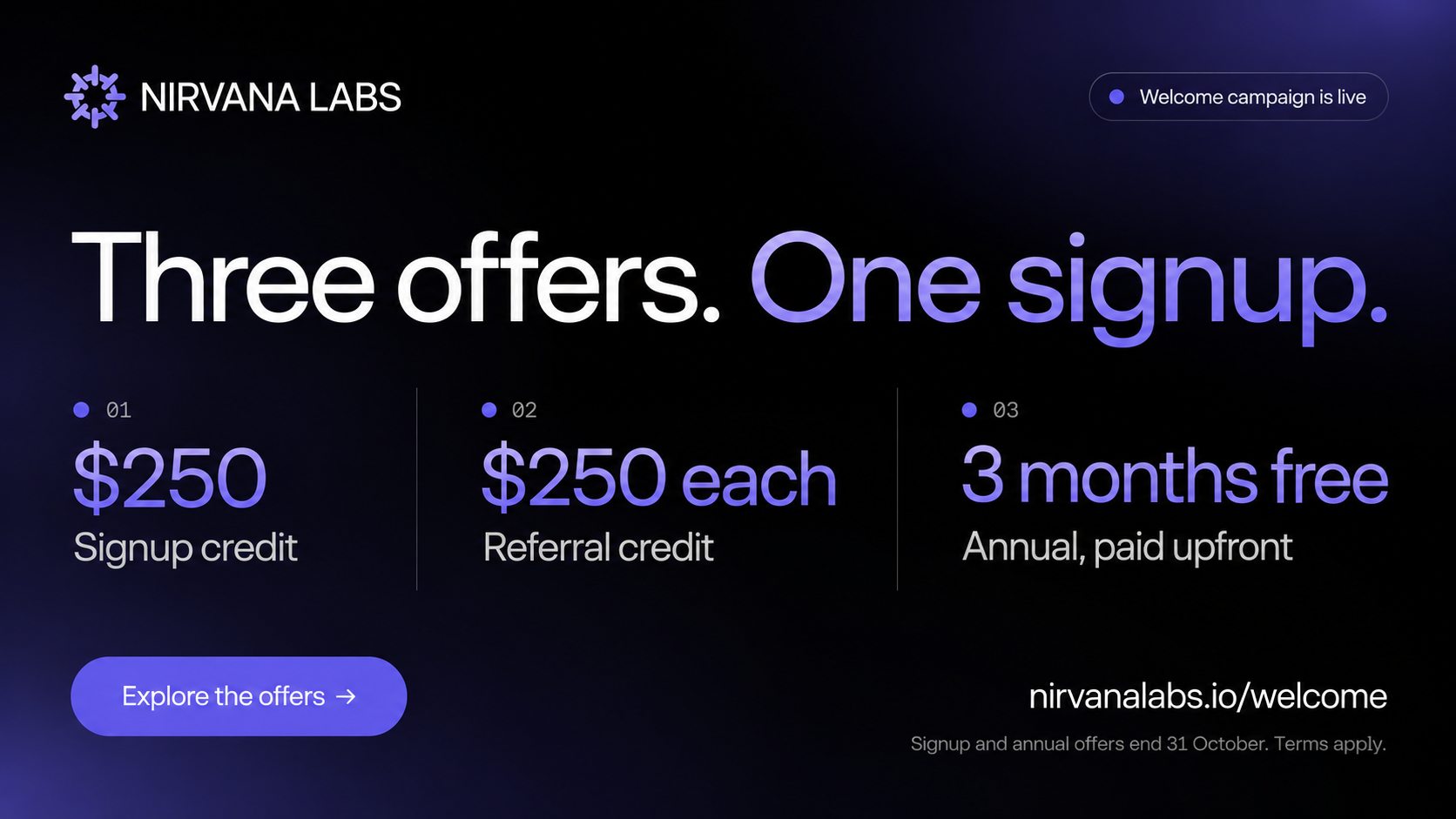
Our welcome campaign gives new accounts $250 in cloud credit to try Nirvana with their own workload. Compute, storage, managed Kubernetes or agent sandboxes: pick a starting point and put it to work.
Nirvana's welcome campaign is live!
— Nirvana Labs (@nirvanalabsai) September 28, 2026
🎁 $250 signup credit
🤝 $250 credit each for referrals
📅 3 months free on annual
All three stack. Ends 31 Oct.
Get started: https://t.co/dzSnbGApUf pic.twitter.com/ST9ggOHGAO
To qualify, create an account, add a payment method and run a qualifying workload. The credit covers eligible invoices until it is used up and expires 90 days after account creation. The signup offer runs through 31 October.
The campaign also includes annual offers: three months free when you commit to twelve months and pay for nine up front, or two months free on a twelve-month commitment billed monthly. Those offers can be combined with signup and referral credit.
Bring a workload you already know. Having a baseline makes the trial useful: you can compare the same application, dataset and traffic pattern on both setups.
See the welcome campaign and full terms →
Our referral campaign is live
If you know a team that could use Nirvana, you can now refer them and earn cloud credit together.
- They get $250 after signing up with your code, adding a payment method and running a qualifying workload.
- You get $250 after their account has been active with a payment method on file for three consecutive months.
- Eligible new teams start with $500 when they combine referral credit with the welcome offer during the campaign.
You do not have to be a paying customer to refer; you need a Nirvana account. Share the link before the team signs up, because a referral code cannot be added to an existing account afterwards.
Each account can earn credit for up to ten qualifying referrals per calendar year. The referral programme continues after the welcome campaign ends.
Get your referral link and see the terms →
With Altinity in San Francisco
We got together with Altinity and the community for Whose Cloud Is It Anyway? in San Francisco on 2 September. The evening focused on BYOC, data sovereignty and cloud costs. Tim’s talk, The Expensive Way to Buy IOPS, took a closer look at the storage part of that bill.
Recap of our SF evening with @AltinityDB on BYOC.
— Nirvana Labs (@nirvanalabsai) September 8, 2026
Our own @csnirvana on "The Expensive Way to Buy IOPS".
1 TB, 20k sustained IOPS per month:
gp3 $200, 60% of it the meter
io2 $1,425, 91% meter
ABS $94.90, no meter.
If the meter is most of your bill, that's the expensive way.… https://t.co/Y3yuECFZLr pic.twitter.com/Wg9QF13uhV
The takeaway: capacity and performance are different purchases. A dataset can stay the same size while its IOPS requirements increase, and separately metered performance can become a large part of the monthly cost.
That matters most for workloads with sustained I/O demand, such as busy indexers, heavy ingestion and queries against data that no longer fits in memory. It does not mean every database needs a premium storage tier. The workload determines whether the extra performance is useful.
Nirvana ABS includes 20,000 sustained baseline IOPS per volume. The useful comparison is the total cost of delivering your workload’s required latency and throughput, including the compute needed to reach it.
For teams exploring managed ClickHouse® on Nirvana, start with a trial at Altinity.Cloud.
ICYMI: Read the meetup write-up →
A new POC in motion
We are working on a new proof of concept with a team that already handles more than 2 billion API requests a month.
The evaluation is still in progress. More to share as the work develops.
What is a harness?
“Agent,” “model,” “harness” and “sandbox” often get used as if they mean the same thing. This month, we published a guide to what each part does.
"Agent harness" is trending @OpenAI @vercel @LangChain all have one. So what is it?
— Nirvana Labs (@nirvanalabsai) September 16, 2026
Agent: the worker
Model: the thinking
Harness: the doing
Sandbox: the workspace
Check out the blog for a full explainer:https://t.co/xRFUlHruVc#AIagents #devtools pic.twitter.com/vDH2j90vbo
- The model decides the next step and produces a response or tool call.
- The harness runs the loop, executes tools, manages context and enforces limits.
- The sandbox provides the environment where generated code runs.
- The agent is the system doing the job across those parts.
That distinction becomes useful when a job runs for hours. Something must keep track of completed work, tool results, pending approvals and the information needed for the next step. Choosing a model is only one part of building that system.
Read the full harness explainer →
Choosing infrastructure for long-running agents
Our hosting guide starts with a practical question: what does the application need to preserve when a worker stops?
Workspace files, workflow checkpoints and process memory are different kinds of state. A retained volume can hold files while a replacement process starts. Checkpoints tell that process which steps have been completed. A memory snapshot addresses the running process itself. Applications also need to handle external actions safely when work is retried.
For Nirvana Agent Sandboxes, a persistent workspace on ABS gives saved files a lifecycle separate from compute. The application still needs to restart and use its committed progress to continue.
The guide compares hosting choices by workload fit, execution limits, persistence and recovery. The point is to test the failure your application must survive, alongside the performance of a normal run.
Read the long-running agent hosting guide →
Why we are building a high-performance storage cloud
We also published the thinking behind Nirvana’s architecture. ABS is the starting point, with compute, networking and Kubernetes built around the needs of applications that keep reading and writing data.
That gives our database, blockchain and agent work a common direction. An indexer has to keep up with incoming data. A database must serve queries when the working set reaches disk. An agent needs somewhere to commit the work it has already done.
Those workloads need different application designs, but sustained storage performance matters to all of them. The article explains how separating storage from compute, keeping the data path close, and including baseline IOPS shape the cloud we are building.
Read the high-performance storage cloud article →
More from the blog
- How to Choose Cloud Infrastructure for a Vector Database — Evaluate query latency, recall and concurrency together, and identify the bottleneck before choosing infrastructure.
- How to Choose Kubernetes Storage for High IOPS Workloads — A practical framework for comparing volume performance, operating models and application recovery.
Bring a workload in October
The welcome campaign runs through 31 October. Pick a workload you understand, establish its current baseline, and use the credit to compare performance and cost on Nirvana. If you know another team with a similar challenge, send them your referral link too.
Get started with Nirvana → Refer a team →
About Nirvana Labs
Nirvana Labs is a high-performance storage cloud purpose built for blockchain, AI and databases i.e. the most demanding, real-time, stateful workloads. Accelerated Block Storage (ABS) offers 20K baseline IOPS included, no over provisioning. Nirvana Kubernetes Service (NKS) with Karpenter auto-scaling, high clock-speed compute and private networking. Backed by Jump Trading, Crucible, etc with 50+ customers live in production today.
Learn more at Nirvana Labs
Nirvana Cloud | Pricing | Blog | Docs | Changelog | LinkedIn | Twitter | Telegram | YouTube
Related Posts
Nirvana Labs Welcome Campaign is Live.
$250 in credit to start. $250 each way when you refer a team. Two or three months free on annual. They stack.
Nirvana: The High Performance Storage Cloud
Why Nirvana is the High Performance Storage Cloud: purpose-built ABS with 20,000 sustained IOPS included, benchmarks against gp3 and io2, who runs on it, and what opens in Q4.
Nirvana Labs August 2026 Recap
Our POC partner Quirq benchmarked Nirvana sandboxes against GKE and E2B on a "machine can disappear" test. Nirvana recovered every checkpoint. E2B lost them all.
Powering AI, blockchain, and
databases
