High-Performance Storage Cloud

SOCII Type2
Compliant
Nirvana LabsBuilt for latency sensitive, data heavy systems

Enterprise-Grade Performance

High-performance infrastructure without the complexity and cost. Deploy in seconds.

K8S
Fully Managed Orchestration
3.3GHz +
Clock Speeds
Sub-ms
Read/Write Block Storage
GB→PB
Enterprise Scalability
Nirvana LabsTrusted by Performance-First Teams
Optimism
Monad
Nansen
eRPC
Goldsky
Aori
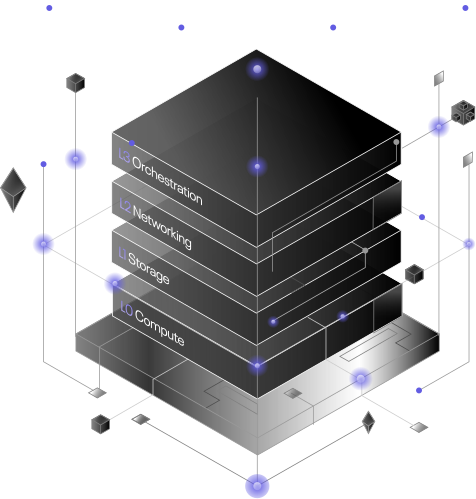
Nirvana LabsNirvana Cloud Stack

Rebuilding The Cloud From The Metal Up
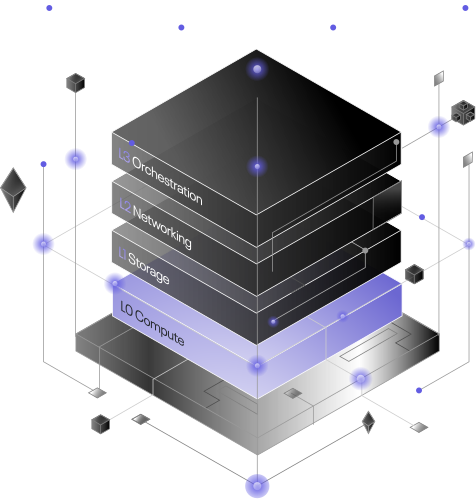
/L0

Compute

Dedicated bare metal with cloud flexibility.

High-clock performance. Spin up VMs in seconds.

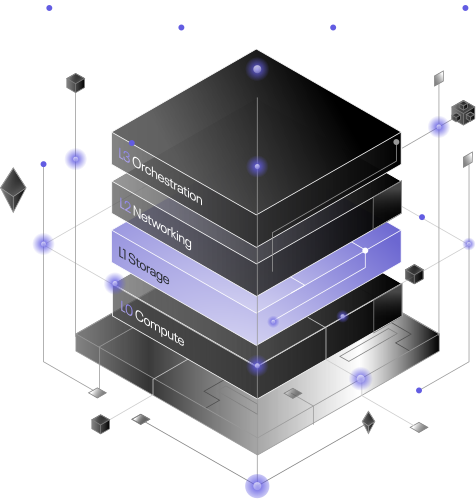
/L1

Storage

Accelerated Block Storage (ABS).

Guaranteed 20,000 baseline IOPS. Sustained under loads.

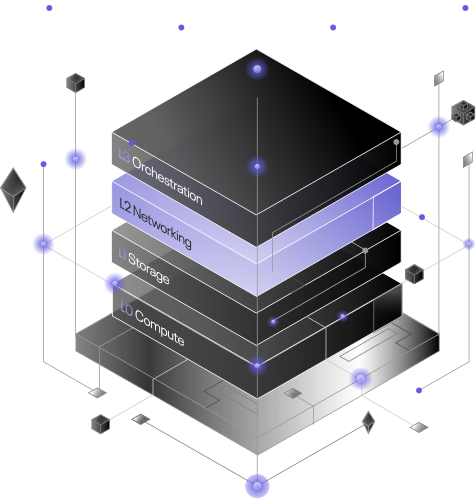
/L2

Networking

Private Internet. No Egress Cost.

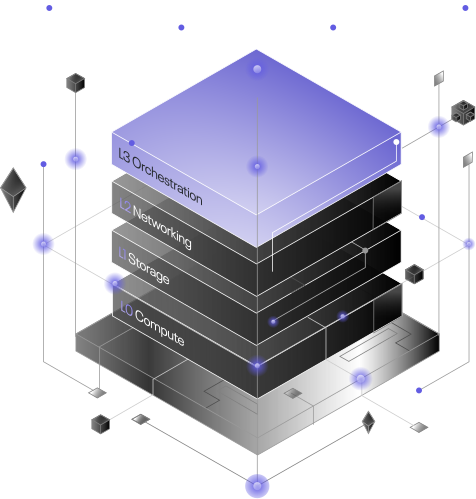
/L3

Orchestration

Nirvana Kubernetes Service (NKS).

Managed orchestration designed for performance-critical systems.

Built For One Thing.
Honest About The Rest.

Nirvana Labs is a performance cloud built around high-IOPS block storage. Adaptive Block Storage delivers 20,000 baseline IOPS with up to 600,000 burst at 0.3–1.5 ms latency, with no burst credits and no degradation over time. Compute, networking and managed Kubernetes are built on the same metal.

Reach for Nirvana Labs when you are

  • Provisioning virtual machines, block storage volumes, VPCs and firewall rules programmatically, via API, Terraform, CLI or SDK.
  • Running IOPS-bound or latency-sensitive workloads — vector databases, OLAP and OLTP databases, blockchain nodes, agent checkpointing — where sustained throughput matters more than burst credits.
  • Standing up managed Kubernetes (NKS) clusters with dedicated controller nodes and customizable worker pools.
  • Running blockchain RPC and archive nodes without operating the underlying infrastructure.
  • Executing untrusted or agent-generated code in isolated Agent Sandboxes.

Look elsewhere for

  • Serverless functions or platform-as-a-service deploys — Nirvana Labs provisions infrastructure, it does not host application runtimes.
  • Object storage or CDN. The storage product is block storage attached to compute.
  • Managed GPU or hosted LLM inference. Published instance types are CPU-only AMD EPYC shapes, and the API exposes no GPU, accelerator or inference resource. Nirvana Labs runs the infrastructure around a model — storage, checkpointing, sandboxes — not the model itself.

Real Performance.
Proven in Production.

"Migrating to Nirvana’s cloud gave us the speed and reliability we needed to scale. Colocating our most critical workloads - our proprietary DEX router - wasn’t just about shaving milliseconds. It’s what allowed us to grow volume fast, expand chains quickly, and hit hundreds of millions in crosschain swaps while giving traders that UX they’ve been looking for."

Aori logomark
Joshua BakerCTOAori
$450MFirst 60 days swap volume
< 800msCrosschain bridging execution
< 4sSub 4s average crosschain swap time

Backed By Leading Venture Capitalists

Jump
Castle Island Ventures
Crucible
Raptor Digital

Common Questions.
Answered Plainly.

What is Nirvana Labs?

Nirvana Labs is a performance cloud built around high-IOPS block storage. Compute, networking and managed Kubernetes run on the same metal, so latency-sensitive and data-heavy systems get predictable throughput instead of the burst-credit model most clouds use.

What IOPS and latency does Adaptive Block Storage deliver?

Adaptive Block Storage delivers 20,000 baseline IOPS with up to 600,000 burst, at 0.3 to 1.5 ms latency. There are no burst credits to exhaust and no degradation over time, so a volume performs the same in month twelve as it did on day one.

Which workloads is Nirvana Labs built for?

IOPS-bound and latency-sensitive systems: vector databases, OLAP and OLTP databases, blockchain RPC and archive nodes, agent checkpointing, and managed Kubernetes workloads. It suits any workload where sustained throughput matters more than peak burst.

What is Nirvana Labs not the right choice for?

It provisions infrastructure rather than hosting application runtimes, so it is not a serverless or platform-as-a-service target. It also does not offer object storage, a CDN, GPUs or hosted model inference — the storage product is block storage attached to compute.

Does Nirvana Labs offer GPUs or managed LLM inference?

No. Every published instance type is a CPU-only AMD EPYC 9354P shape, and the API exposes no GPU, accelerator or inference resource. Nirvana Labs is the infrastructure around a model rather than the model itself: high-IOPS storage for vector databases and agent checkpointing, isolated Agent Sandboxes for agent-generated code, and managed Kubernetes to run the rest of the stack. Model inference belongs with a provider that hosts it.

How do I provision resources?

Through the REST API, the Homebrew-installable CLI, the Terraform provider, the Go and TypeScript SDKs, or the web dashboard. The API is described in an OpenAPI 3.1 document, and the dashboard emits equivalent Go, TypeScript, curl and Terraform for any action you take in it.

Can an AI agent operate Nirvana Labs directly?

Yes. An official Model Context Protocol server, @nirvana-labs/nirvana-mcp, exposes resource management as tools, and the OpenAPI document can be turned into function-calling definitions. API keys carry scoped permissions — read or edit, per resource type and per project — so an agent can be granted least privilege rather than full account access.

How is Nirvana Labs priced?

Usage-based, billed per hour with no minimum commitment. Compute is $0.016 per vCPU-hour and $0.004 per GB of RAM per hour, block storage is $0.00013 per GB-hour, and egress is $0.02 per GB. A billing month is 730 hours, and annual commitments take 20% off.

What uptime is committed in the SLA?

A quarterly uptime target of 99.9% for managed RPC node APIs and Nirvana Cloud. If uptime falls between 99.00% and 99.9% the service credit is 10% of the affected quarterly spend, rising to 20% below 99.00%, capped at 90 days of paid service per quarter and claimable within 30 days. Standard support responds in under 24 business hours.

What does the managed Kubernetes service include?

Nirvana Kubernetes Service (NKS) provisions clusters with dedicated controller nodes and customizable worker pools, plus managed load balancers and persistent volume claims backed by the same block storage. An official Terraform module covers production-ready cluster setups.

How does performance compare to the major cloud providers?

Benchmarks against AWS, GCP and other providers are published with their full methodology and raw numbers, covering storage throughput, LangChain and LangGraph checkpointing, agent sandboxes and the Star Schema Benchmark, so the results can be reproduced rather than taken on trust.

Powering AI, blockchain, and
databases

Talk to Sales