
ABS is the moat. We built the storage, and the rest of the cloud exists to keep up with it.
TL;DR
- Hyperscalers sell fast block storage as a metered tier. Neoclouds are built around GPUs. Nirvana is defining a storage-first cloud: performance-inclusive block storage for hot, stateful, real-time data, with the rest of the cloud built to keep up with it.
- We purpose-built Accelerated Block Storage (ABS) in Silicon Valley and shipped it in January 2026: 20,000 baseline IOPS per volume with no tier to buy, up to 600,000 burst, sub-millisecond latency, up to 1.6 GB/s writes, 32 GB to 4 PB without re-provisioning.
- Measured, not claimed: 10 to 14x median speedup over AWS gp3 on cold-read analytics, io2-class behavior on 77% of the ClickBench suite at roughly one-eighth the cost, fsync in 1.65 ms after a real flush.
- More than 50 customers run on it in production, including Aori, Goldsky, Optimism and Monad.
- Our second site opens in Q4. It is not block storage. It is still high performance.
Why a high performance storage cloud?
A high performance storage cloud is a cloud where storage performance is the baseline, not a metered add-on. Sustained IOPS, sub-millisecond latency and flat pricing are what you get by default, and compute, networking and orchestration are built to serve the disk rather than the other way round.
It exists for one kind of customer: teams whose data is always hot. Stateful, real-time workloads that never get a recovery window. Databases that stay under load around the clock, blockchain nodes and indexers that cannot fall behind the chain, AI agents that checkpoint thousands of times an hour. For these teams storage is not a cost line. It is the thing that decides whether the system keeps up.
No cloud on the market is organized that way today, which is the point.
The cloud landscape nowadays
Look at the cloud landscape.
#1 The hyperscalers sell fast block storage (AWS io2, Google Hyperdisk Extreme, Azure Ultra Disk), but as a metered tier on a commodity layer: gp2 lends burst credits and takes them back, gp3 includes 3,000 IOPS and meters everything above it, io2 delivers at roughly eight times the price and often needs a bigger instance to unlock it.
#2 The neoclouds (CoreWeave, Lambda, Nebius, Crusoe) were built to sell GPUs, and storage is whatever keeps them fed, often someone else's software licensed in; Crusoe runs Lightbits rather than its own.
#3 Developer clouds like DigitalOcean and Vultr have no sustained-IOPS product at all, and object-storage clouds like Wasabi and Backblaze sell capacity by the terabyte, which can sit under an analytical system but is not a low-latency block device for a Postgres primary, a blockchain node or an agent workspace.
Clouds built around compute, GPUs, or cheap capacity. Fast storage is a tier you pay for on top of some of them. None is organized around it. Databases, blockchain nodes, indexers and AI agents sit in that gap and pay for it in burst credits, per-IOPS metering, or io2 invoices.
We built ABS with the performance included, then built the rest of the cloud around it.
ABS is built to stay fast under sustained load
We did not start with a spec sheet. We started with what customers running always-hot workloads kept telling us: storage was fast on day one, and staying fast under sustained load got expensive. Four design decisions follow from that.
Durable storage, decoupled from compute. Instance-local disks die with the instance; network volumes fix that but hand the performance back to the meter. An ABS volume was never part of the VM, so a database or a sandbox can lose its machine and recover onto a new one with its data intact, with sustained performance included.
Parallel by design. High IOPS comes from doing many small things at once, not making one thing faster. ABS spreads work across nodes, so performance scales linearly with capacity instead of hitting a per-disk ceiling.
That is also what makes big transfers fast. A large read or write is striped across many nodes and serviced at once, so sequential throughput scales with the nodes behind the volume, not one disk's ceiling. It shows up where it matters: full-table scans and large aggregations, the queries where gp3 fell off a cliff on cold reads, ran 10 to 14x faster on ABS. Up to 1.6 GB/s writes, and reads that hold steady after hours of continuous load.
An isolated data path on the same rack. Storage I/O is kept apart from management and customer-facing traffic, and compute and storage are colocated on the same rack, so the path between a workload and its volume never leaves the rack and traffic between them costs $0.
Performance included, not metered. No burst credits, no per-IOPS provisioning line. Every volume gets 20,000 IOPS sustained indefinitely, and bursts to 600,000 from real spare capacity.
The result is a storage layer that moves large chunks of data fast and keeps doing it. Up to 1.6 GB/s write throughput. Latency between 0.3 and 1.5 ms. Volumes from 32 GB to 4 PB, resized live with no downtime.
The benchmarks show Nirvana ABS beats AWS, GKE, E2B
Every number below has a published methodology and a reproduction repo. A number without a repo is a claim, not a proof.
ClickBench, cold reads. 43 analytical queries against the hits_100m dataset with the OS page cache dropped before every query, on identical 64 vCPU, 512 GB machines. ABS delivered a 10 to 14x median speedup over EBS gp3 on IO-heavy queries, and matched io2 within 1.5x on 77% of the suite and within 2x on 98%. Normalized to 1 TB at 10,000 sustained IOPS, ABS costs about $96 a month against roughly $778 for io2.
LangChain agent workloads. Across 18 runs against four AWS storage configurations, with identical durability settings and every Postgres commit waiting on WAL fsync, Nirvana finished ahead on end-to-end duration in all 18. The lead grew with load: 24 to 28% at 100,000 checkpoints.
Durability under failure. In Quirq's benchmark against GKE and E2B, all 5,501 committed checkpoints came back on a brand-new pod after an ungraceful kill. fsync returned in 1.65 ms after a real flush.
Star Schema Benchmark, with Altinity. Single-node ClickHouse managed by Altinity on Nirvana: 34 to 63 ms on warm selective queries and roughly 70M rows per second on storage-bound scans. This was not a cross-cloud comparison; it measures what the joint stack does on its own. Full report at nirvanalabs.io/benchmark-results/ssb.
Who runs on the storage cloud today?
More than 50 customers are live in production. Aori cleared $450M in swap volume in its first 60 days on Nirvana with sub-800 ms cross-chain execution. Goldsky cut Elasticsearch latency from 15 ms to under 5 ms across 100 TB of always-hot chain data. Optimism and Monad run core infrastructure here. Altinity runs ClickHouse BYOC on Nirvana, and Quirq benchmarks its agent runtime on it.
The common thread is not the vertical. It is the I/O profile: continuous load, no recovery window, and a business that notices when storage slows down.
What comes next?
ABS lives in Silicon Valley today, in us-sva-2, and that is where every number above was measured.
In Q4 we open our second site. It is built on the same private-infrastructure model, one control plane, one account, two US regions. And the storage under it is not block storage. It is still high performance, and it will ship with a published benchmark and a reproduction repo, the same way ABS did.
A high performance storage cloud has to be a property of Nirvana, not a property of one building. Q4 is when we prove that.
See you then.
About Nirvana Labs
Nirvana Labs is a high-performance storage cloud purpose built for blockchain, AI and databases i.e. the most demanding, real-time, stateful workloads. Accelerated Block Storage (ABS) offers 20K baseline IOPS included, no over provisioning. Nirvana Kubernetes Service (NKS) with Karpenter auto-scaling, high clock-speed compute and private networking. Backed by Jump Trading, Crucible, etc with 50+ customers live in production today.
Learn more at Nirvana Labs
Nirvana Cloud | Pricing | Blog | Docs | Changelog | LinkedIn | Twitter | Telegram | YouTube
Related Posts
Nirvana Labs September 2026 Recap
September at Nirvana: $250 signup credit, referrals, the Altinity meetup, a new POC, and guides to harnesses and long-running agents.
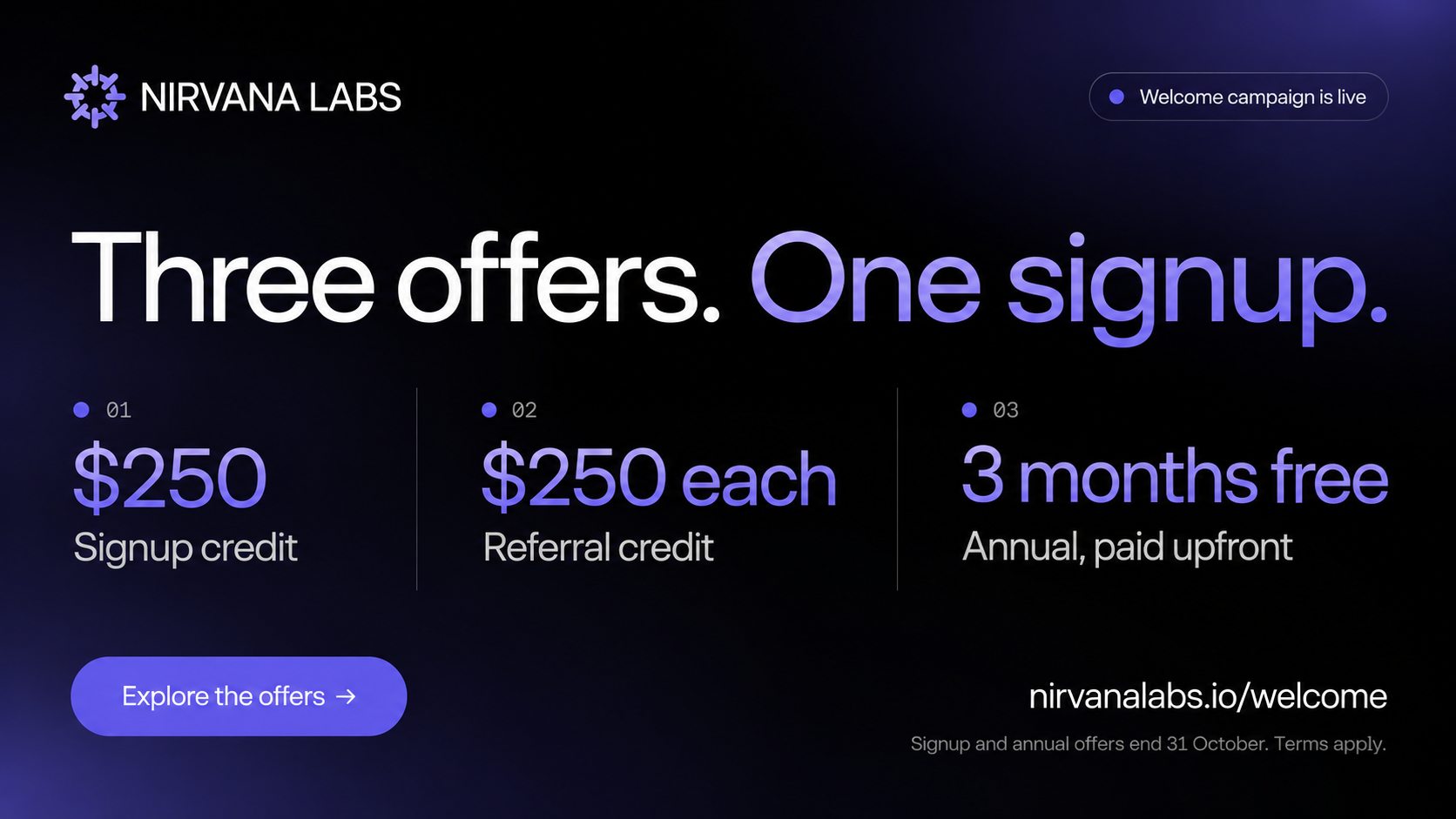
Nirvana Labs Welcome Campaign is Live.
$250 in credit to start. $250 each way when you refer a team. Two or three months free on annual. They stack.
Nirvana Labs August 2026 Recap
Our POC partner Quirq benchmarked Nirvana sandboxes against GKE and E2B on a "machine can disappear" test. Nirvana recovered every checkpoint. E2B lost them all.
Powering AI, blockchain, and
databases
