Powering Fast
Swaps x Aori
Leveraging co-location services from Nirvana to reduce latency and increase
settlement throughput





6 chains in weeks: Controlled Scaling to Optimism, Ethereum, Arbitrum, Base, Plasma, and BNB Chain with massive load increases.
"Migrating to Nirvana's cloud gave us the speed and reliability we needed to scale. Colocating our most critical workloads - our proprietary DEX router - wasn't just about shaving milliseconds. It's what allowed us to grow volume fast, expand chains quickly, and hit hundreds of millions in crosschain swaps while giving traders that UX they've been looking for"

Partnership Case Study
 SUMMARY
Aori is a high-frequency intent protocol that powers LayerZero Labs's Stargate Fast Swaps. Aori runs its intent router directly on Nirvana Cloud, co-located with dedicated node pools. This delivers sub-800ms bridge execution and sub-4s settlement across six chains - truly instant cross-chain swaps.
Aori is a high-frequency intent protocol built on LayerZero — off-chain matching, deep liquidity aggregation, and atomic settlement in a single MEV-protected transaction.
Solvers compete to fill signed intents instantly, fronting liquidity and absorbing finality and slippage risk. Aori compresses that risk so solvers quote tighter and fill faster.
Nirvana provides the low-latency foundation: dedicated RPC, co-located compute, and private networking.
Early setups on generic clouds and shared RPC pools offered reliability but not control. Calls hit different nodes inside shared pools, creating variable latency and unpredictable tail behavior. Per-call pricing scaled poorly.
Nirvana eliminated this with dedicated node pools, chain-proximate cloud, and private network paths - no public-internet jitter, no sequential-call drift.
Unlike generic clouds, Nirvana co-designs the stack with partners: tuning latency, routing, and HA architecture around real execution flow.
With compute, nodes, and networking in a single setup, Aori avoids cross-cloud egress entirely and gets the speed and determinism solvers depend on.
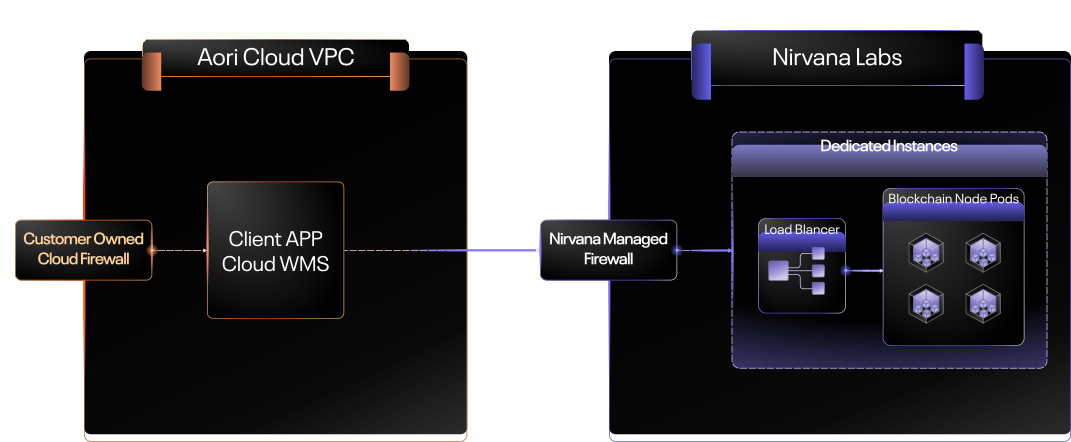
The Set-up
Use Cases
Co-located compute for ultra-low latency intent execution

Aori's DEX router needs near-instant resolution to avoid race conditions and slippage. Generic cloud introduced unpredictable latency and high egress costs.
Co-located the routing engine beside dedicated RPC nodes - consistent sub-5ms block access and a routing architecture built for high-frequency intent flow.
Fast Multi-Chain Rollout
Aori needed to expand to new chains fast without engineering bottlenecks - scaling from four initial chains to Plasma and BNB, with Monad and Stable next.
Dedicated node pools across 90+ networks with routing-optimized configs. Aori plugged into new chains and went from single-chain to multi-chain execution in weeks.
Node-to-Fit Scaling
Early volumes ran on VMs, but growing orderflow demanded bare-metal performance without over-provisioning.
VM-to-bare-metal migration with flexible node pool scaling - right-sized spend and predictable performance under high load.
Private Connectivity

Public internet routing introduced latency spikes and jitter. Aori needed full network control.
Private interconnect across Nirvana's network - dedicated, non-internet paths for high predictability and zero egress exposure.
High-Availability Load Balancing
Aori runs across BNB, Base, Ethereum, Optimism, and Arbitrum with tight block-lag tolerances. Per-chain load balancers without HA created single points of failure.
HA load-balancer pairs with custom block-lag thresholds — lagging nodes auto-eject, recover, and rejoin. Terraform and Ansible automate the full workflow.
The Journey
June 2025
Partnership
Initial integration begins with Aori connecting their DEX router (hosted on GCP) to Nirvana's Optimism node pool.
July 2025
First Integration
OP router on GCP connects to Nirvana's Optimism node; testing shows Wisent needs to be co-located on Nirvana Cloud.
Early August 2025
Multi-chain Build-out
Base, Ethereum, and Arbitrum provisioned; node pools grow from single nodes to 4-node pools
Mid August 2025
VM to Bare Metal
Routing moves to bare metal; pools expand to 8 nodes for launch.
Late August 2025
Go-live
Four co-located node pools launch in Silicon Valley, eliminating egress and stabilizing sub-5 ms latency.
September 2025
Plasma Live
October 2025
BNB Added
November 2025
Zero-day Launch Prep
HA load-balancer pair deployed for upcoming Stable and Monad integrations.
Powering AI, blockchain, and
databases
