
August was about external validation.
Our POC partner Quirq benchmarked Nirvana sandboxes against GKE and E2B on a "machine can disappear" test. Nirvana recovered every checkpoint. E2B lost them all. We ran the joint Altinity × Nirvana BYOC benchmark on 3 billion rows of ClickHouse® data. We contributed native compute and stateful storage to Technocore by flop_labs, the emerging agent-to-agent protocol.
Here's what moved.
Quirq Benchmarks Nirvana vs GKE vs E2B: The Machine Can Disappear
Our POC partner Quirq benchmarked agent sandboxes on Nirvana vs GKE vs E2B. The question they asked was simple: kill the machine mid-task, does the work survive?
The result:
- Crash test 1: Checkpoints: Nirvana recovered all 5,501. E2B recovered 0.
- Crash test 2: 200-module build, crashed mid-run: Nirvana and GKE kept every compiled module. E2B lost the work.
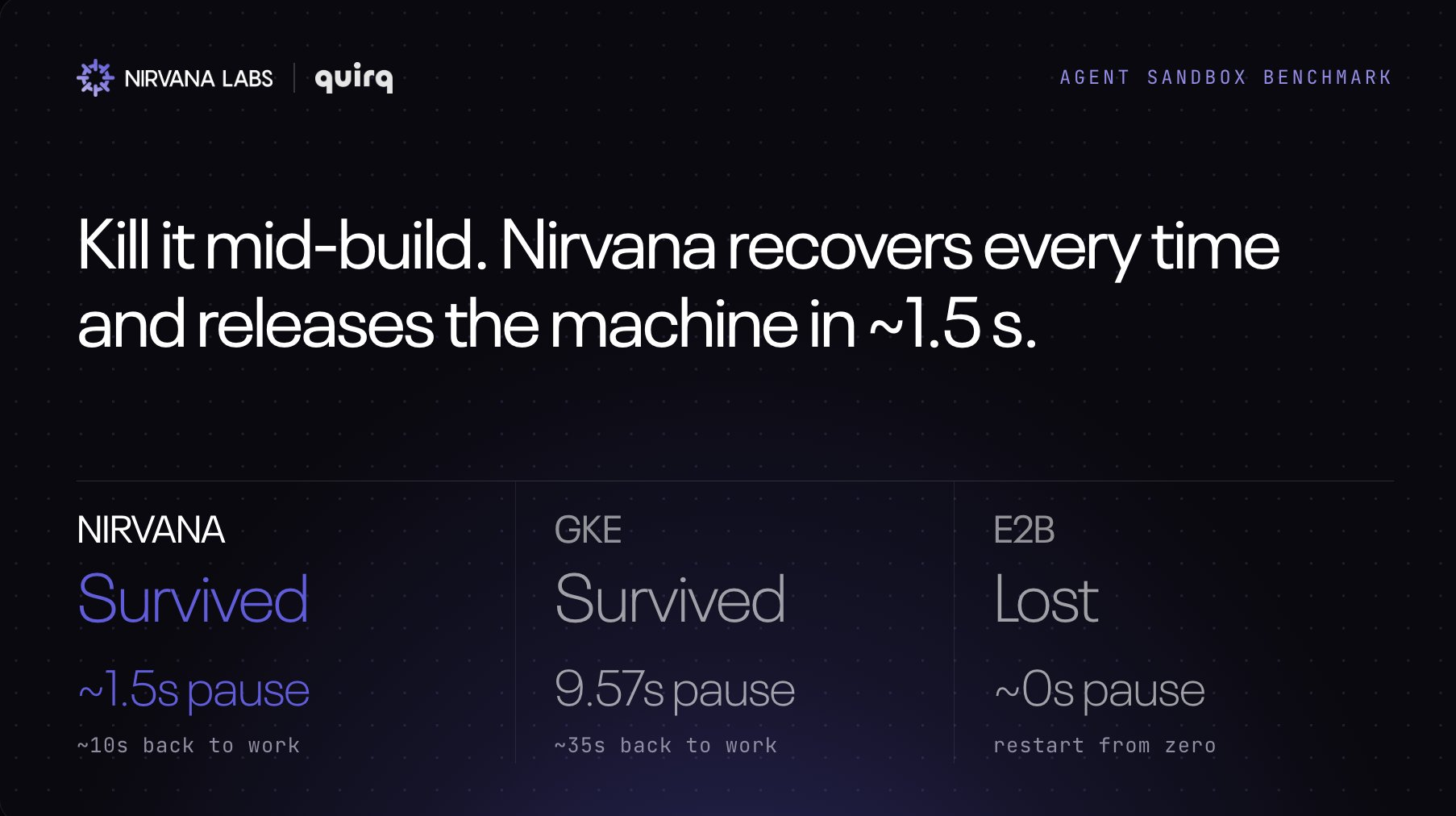
Machines die a lot. Most sandboxes keep agent work in RAM, so when the machine dies, the work dies with it. Storage that outlives the machine (a real disk) means you can pause, the work stays put, and a new machine picks up where the last one left off.
Full writeup with methodology and raw numbers: https://docs.quirq.ai/research/experiments/machine-can-disappear
Contributing to Technocore
Nirvana Labs is now a Technocore contributor. Technocore, by flop_labs, is the emerging protocol for agent-to-agent coordination. We're providing the native compute and stateful storage substrate for FLOP agents.
Agents need infrastructure that persists across sessions and platforms. That's exactly what ABS and NKS were built for.
Get your own stateful infra for your FLOP agents: https://nirvanalabs.io
Altinity × Nirvana BYOC: SSB Benchmark on 3 Billion Rows
Benchmarking is a prerequisite, not an option.
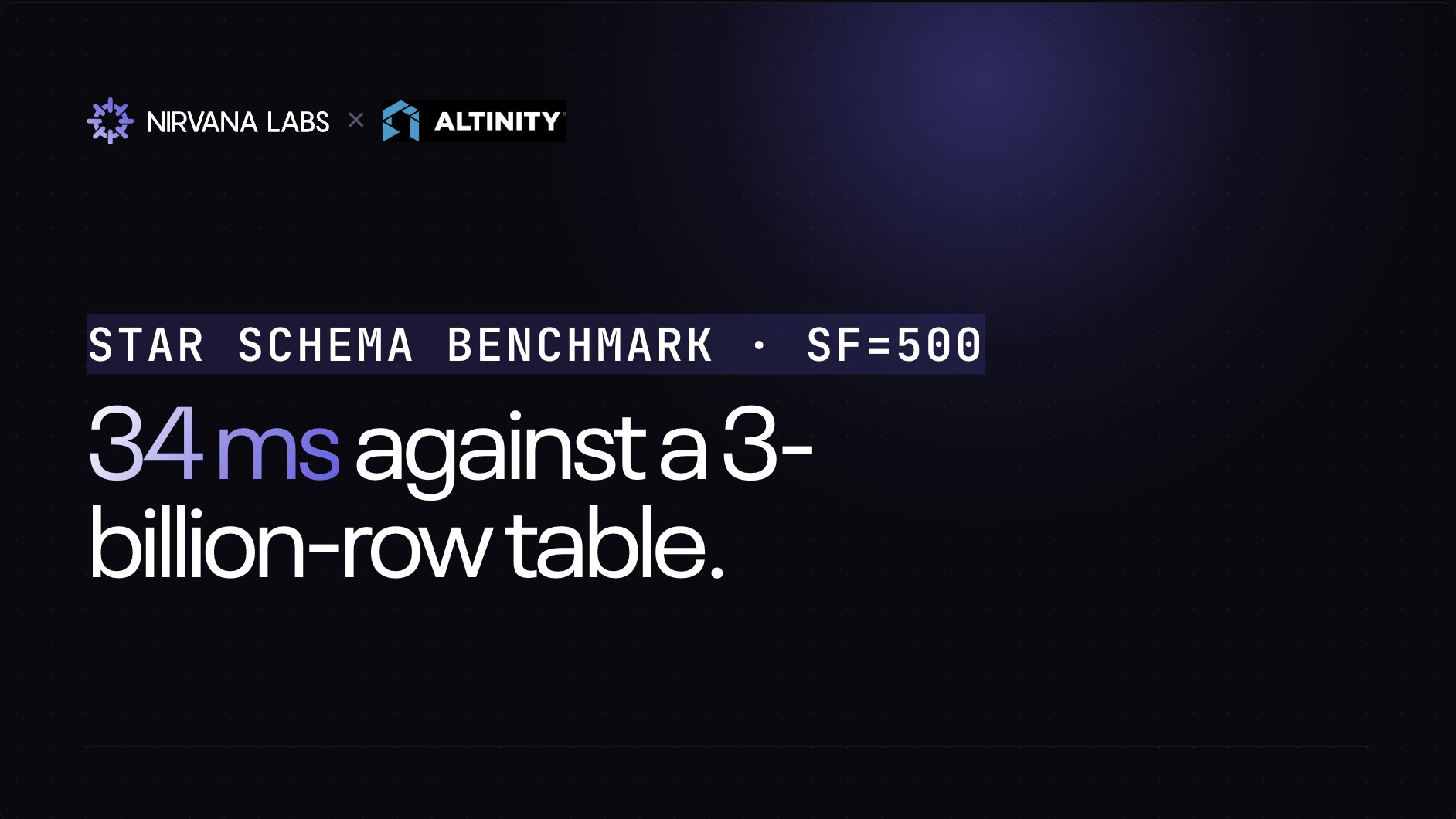
The joint stack: single-node ClickHouse® managed by Altinity on Nirvana. SSB at SF=500. 3 billion rows, working set past RAM, no cache to hide behind.
- Selective queries: 34ms warm. About one frame of film. (Or a fraction of the 100-300ms human blink.)
- Full scans: ~70M rows/sec sustained from disk.
Full methodology included, not just the numbers. Every check we ran before we believed them: join fanouts, disk near-fills, and the validation steps that catch both.
Full report: https://nirvanalabs.io/benchmark-results/ssb
Blog: https://nirvanalabs.io/blog/ssb-clickhouse-nirvana-altinity
New in the Nirvana API: Per-VM Metrics and Resource Filtering
Every Nirvana VM now surfaces what it's doing (CPU, memory, disk, network) live in the Dashboard and the API, with 30 days of history. And every list endpoint (VMs, volumes, audit logs, billing history, and more) now supports filtering and sorting with a single query param instead of a pagination loop. Rolling out in the Dashboard too.
Blog: https://nirvanalabs.io/blog/blog-nirvana-api-vm-metrics-resource-filtering
Agent Sandboxes Comparison 2026: Four Sharper Takeaways
We updated the definitive agent sandbox comparison with four takeaways from digging deeper into 13 providers' docs (E2B, Daytona, Modal, Vercel, Blaxel, Cloudflare, Northflank, Fly, Beam, Railway, AWS, Google, and us):
- "Persistent" means four different things. Snapshot pipelines, object storage mounts, tiered filesystems, or one live block-storage disk. Nirvana is the only documented, benchmarked live disk. /workspace just stays there. No snapshot step.
- Snapshots charge a toll on the way in. E2B documents ~4s per GiB to pause. Blaxel ~15s to enter standby. Many snapshots expire in 7-30 days. 8 of 13 providers don't publish pause times at all. Our pause has nothing to copy, so there's no toll.
- Isolation is a layering choice. The microVM camp has the strongest per-sandbox walls. Our answer is layers: container walls, VM-isolated nodes, and a dedicated cluster per customer. SOC 2 Type II. Nobody else does dedicated by default.
- New recipe: run persistent sandboxes even for disposable jobs. Boot once, pause, and every job after starts with a resume instead of a boot. Exception: fan-out (forking 50 copies is snapshot territory).
Every cell sourced from vendor docs, checked August 2026.
Full comparison: https://nirvanalabs.io/blog/agent-sandboxes-comparison-2026
The Altinity × Nirvana Joint Stack Architecture
How the joint stack keeps ClickHouse® data always hot, layer by layer:
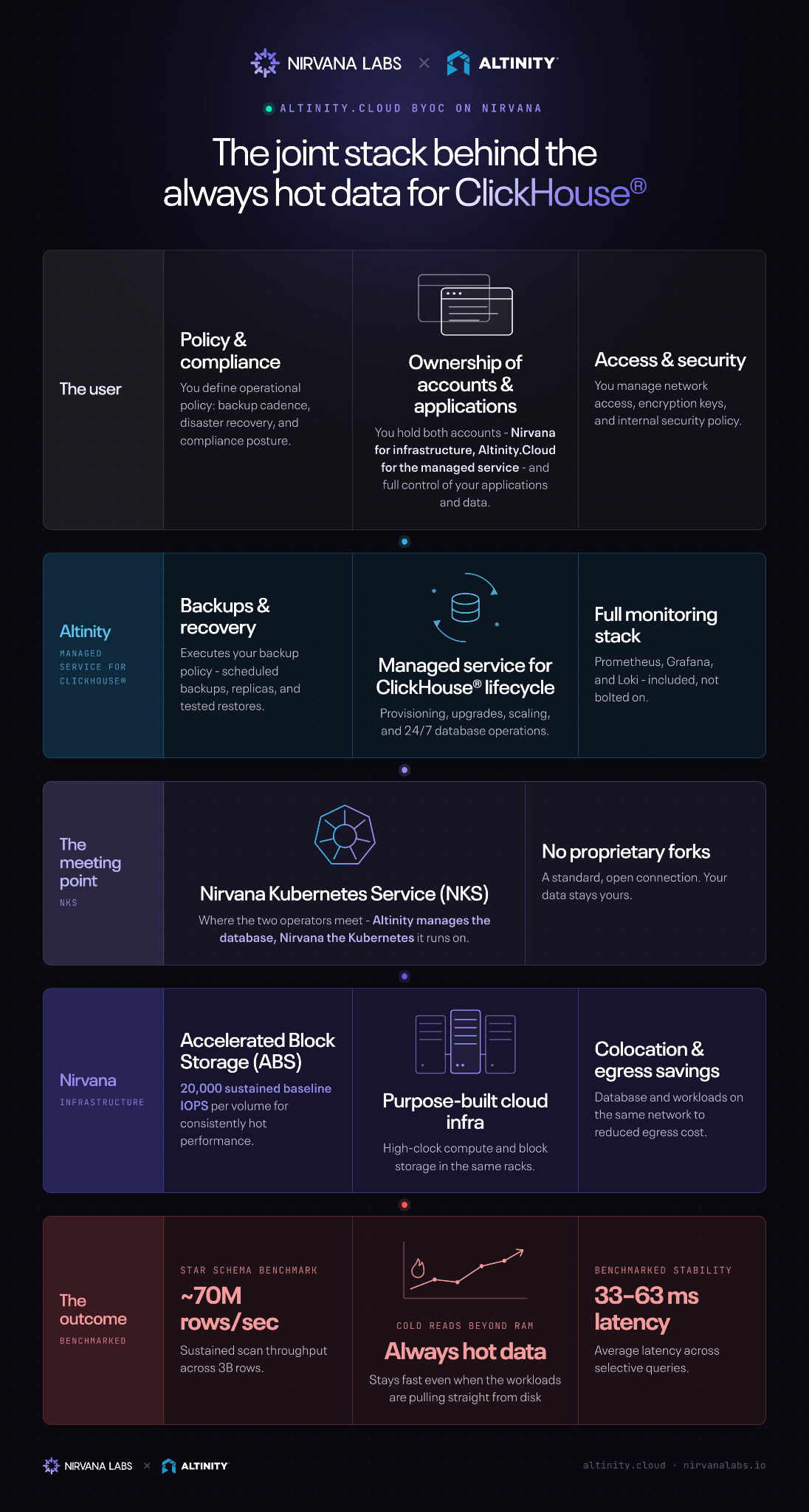
- Layer 1: You (the user). Your applications, pipelines, dashboards, business logic. Your Nirvana account and access policies. Your topology calls: compute shape, storage size, shards and replicas. You own what the data means.
- Layer 2: Altinity, everything database. Cluster creation, upgrades, rescaling, monitoring. The operator, the console, access controls. Their ClickHouse® engineers on schema design and query optimization. Managed service for ClickHouse® since 2017.
- Layer 3: Nirvana, everything below Kubernetes. NKS control plane, dedicated high-clock compute, ABS block storage with 20,000 IOPS included, no per-IOP surcharges. When your workload runs here too: same rack, $0 internal egress.
The outcome: always hot data. Not "everything lives in RAM." Performance that holds when queries hit the disk. 34ms selective queries on 3B rows, stable run to run.
Full architecture breakdown: https://nirvanalabs.io/blog/altinity-x-nirvana-the-joint-stack-clickhouse-data
Your Database Deserves Better Storage, Part 2: The Hyperscaler Trap
AWS gp3 is usually the go-to for BYOC. Works great until a cache miss. Then queries jump from sub-second to tens of seconds.
The fix is io2. It works, but it costs 8x more. Stable app or sustainable margins: pick one.
AWS gp3 is usually the go-to for many BYOC. Works great until a cache miss. Then queries jump from sub-second to tens of seconds.
— Nirvana Labs (@nirvanalabsai) August 6, 2026
The fix is io2. It works bur it also costs like 8x more. Stable app or sustainable margins, pick one.
That's why "Your Database Deserves Better… pic.twitter.com/2KMk5h9ocE
That's the hyperscaler trap. Watch Part 2 for the walkthrough.
Part 1:
https://x.com/nirvanalabsai/status/2081726727789900189?s=20
From the Blog & Community
Agent economics: 80 extra billable days per year. Checkpoint writes run 24-28% faster on Nirvana than on AWS in our LangChain benchmark. That's 5+ hours a day, 6 days a month, 80 days a year of extra agent output. If your agents make you money, they make it faster on Nirvana.
Sandboxes can expire. Your agent saved its work. Came back 8 days later. Gone. On several sandbox platforms, saved state has an expiration date: 7 days on one, 30 on others. Live disks don't usually expire. Sandbox snapshots often do.
GPU starvation is a multi-layer problem. Many companies shipped fixes since July 1. The fix comes from the full data path: storage, metadata, caching, memory, interconnects, and the software that keeps those layers working ahead of the GPU. https://x.com/nirvanalabsai/status/2089434618118463978?s=20
Cloud supply is real, and it's not just AWS. AWS capacity spoken for through 2028. Akamai's GPU fleet sold out. CoreWeave is signing multi-year deals just to get SSDs. Pure locked in flash supply through FY2028. Renting is real.
If you resell AWS (or any other hyperscaler), we should work together. Your customers pay the same and get better performance. You keep the margin. Book time with sales.
Pricing calculator walkthrough on YouTube. Nobody needed one because it's dead simple. Here it is anyway. Compare against AWS line by line on compute, storage, and networking.
Come Say Hi in SF

Whose Cloud Is It Anyway? Tuesday, September 2 · 6-9 PM PT · San Francisco
Nirvana × Altinity evening on BYOC architecture. Our own @csnirvana presents The Expensive Way to Buy IOPS: the slider ends at 16,000, then the meter starts.
Register: https://luma.com/ruft92qf
What's Next
More partner benchmarks. More BYOC customers going live. And more insights on the agent economics story as teams start shipping persistent agents in production.
About Nirvana Labs
Nirvana Labs is a high-performance storage cloud purpose built for blockchain, AI and databases i.e. the most demanding, real-time, stateful workloads. Accelerated Block Storage (ABS) offers 20K baseline IOPS included, no over provisioning. Nirvana Kubernetes Service (NKS) with Karpenter auto-scaling, high clock-speed compute and private networking. Backed by Jump Trading, Crucible, etc with 50+ customers live in production today.
Learn more at Nirvana Labs
Nirvana Cloud | Pricing | Blog | Docs | Changelog | LinkedIn | Twitter | Telegram | YouTube
Related Posts
Nirvana Labs September 2026 Recap
September at Nirvana: $250 signup credit, referrals, the Altinity meetup, a new POC, and guides to harnesses and long-running agents.
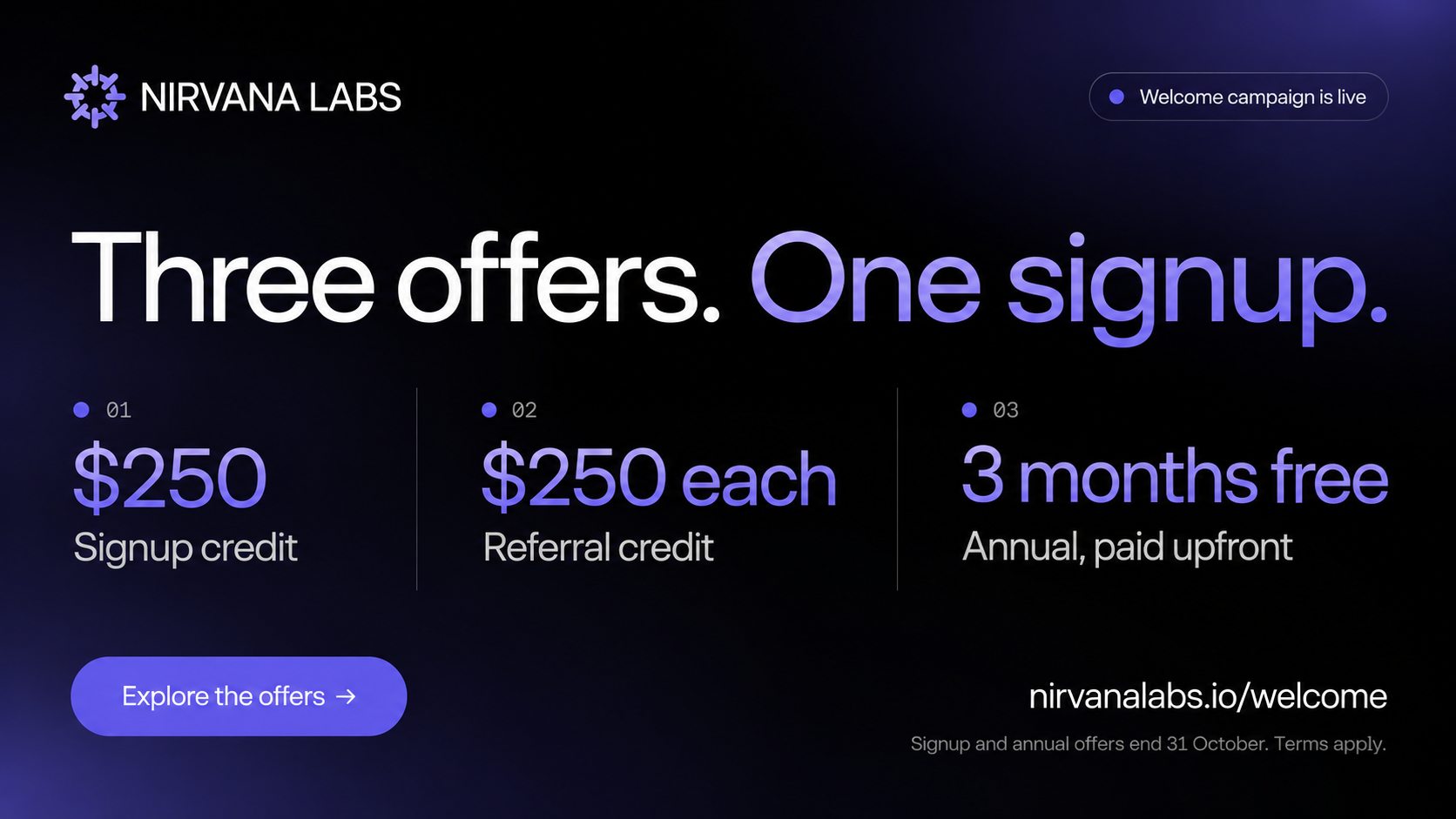
Nirvana Labs Welcome Campaign is Live.
$250 in credit to start. $250 each way when you refer a team. Two or three months free on annual. They stack.
Nirvana: The High Performance Storage Cloud
Why Nirvana is the High Performance Storage Cloud: purpose-built ABS with 20,000 sustained IOPS included, benchmarks against gp3 and io2, who runs on it, and what opens in Q4.
Powering AI, blockchain, and
databases
