

June was all about the LangChain Agent Infrastructure Benchmark - the largest piece of benchmarking work we've ever published, plus the back story, explainers, and insights that came with it.
We ran 100K LangChain tasks at up to 1,000 concurrent agents on Nirvana ABS vs AWS io2 and gp3. We open-sourced the entire benchmark so anyone can run it. We wrote the backstory of why a cloud company benchmarks an LLM framework. We broke down what LangChain, LangGraph, and LangSmith each actually do. And we walked the floor at SuperAI Singapore to see how everyone else is thinking about AI infrastructure.
Here's what moved.
The LangChain Agent Infrastructure Benchmark Is Live
The headline:
- 14–17% faster task completion than AWS io2
- 19% more throughput
- 7.8× faster raw disk performance
We compared Nirvana vs AWS to see how much infrastructure can improve agent speed — specifically the data and storage layer in the ReAct loop. 5 configs. 100K tasks. 1,000 concurrent agents. Cold reads. 3 runs each.
- Full report: https://nirvanalabs.io/benchmark-results/langchain
- Open-source repo: https://github.com/nirvana-labs-examples/langchain-benchmarks
- Blog: https://nirvanalabs.io/blog/langchain-benchmark
Task completion matters. Your agents, faster.
Why a Cloud Company Benchmarks an LLM Framework
Before the results, we wrote the backstory.
We build cloud and high-performance block storage. When we broke down how LangChain agents work, the data and storage layer is exactly where what we build directly affects how fast agents finish work. So that's what we benchmarked.
Read the backstory: https://nirvanalabs.io/blog/langchain-benchmark-background
What Is LangChain?
A short primer for anyone catching up on LangChain vs LangGraph vs LangSmith
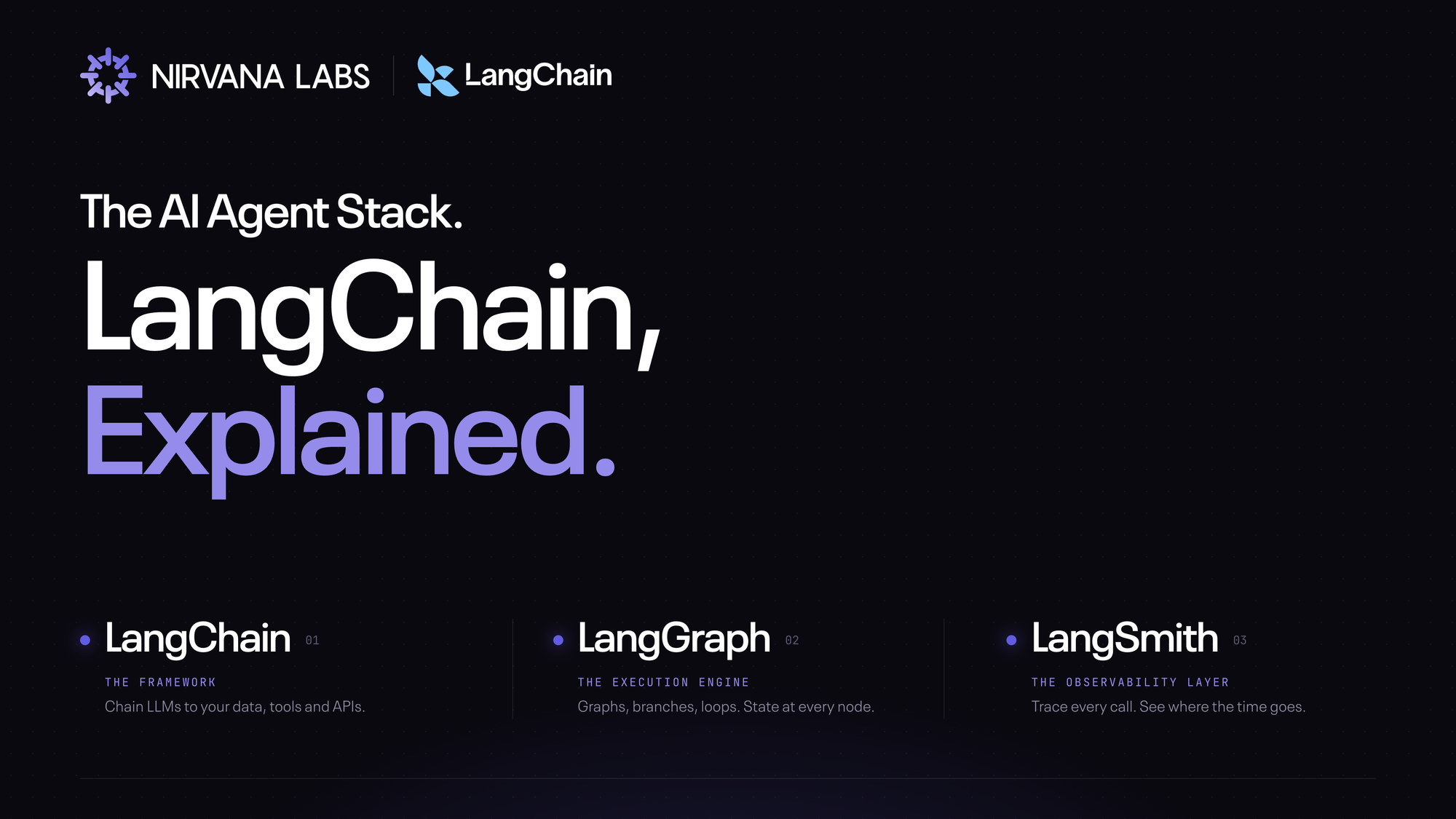
- LangChain is a Directed Acyclic Graph (DAG) — flow goes one direction, no loops. The building blocks.
- LangGraph breaks the "acyclic" part by allowing cycles, which is what makes agents possible. Loop back, retry, branch. The execution engine.
- LangSmith is the observability layer — it traces every LLM call, every tool invocation, every graph step. It tells you where the time goes, what failed, and what it cost. The debugger for your agents.
The infrastructure underneath sets the pace. We benchmarked it. 100K tasks, cold reads, ABS finishes 14–17% faster than io2 at every scale.
Full blog: https://nirvanalabs.io/blog/what-is-langchain-langgraph-langsmith
The Three Types of Storage: File, Object, Block
Quick refresher on storage shapes, because they aren't interchangeable.
- File → folders inside folders, like a filing cabinet many people open at once. Great for shared training sets (WEKA, FSx). Slows down as folders get deep.
- Object → a giant bucket of files reached over an API (think S3). Cheapest and biggest. Great for backups, data lakes, model weights. Useless for live databases — every read is a network round trip.
- Block → raw chunks on a disk attached to one machine, each with an exact address. The fastest path to data. Where Postgres, ClickHouse, blockchain nodes, and trading order books live.
For agents, every step writes memory, context, and logs. A thousand agents at once is a flood of tiny writes in the critical path. That's block storage's job.
Nirvana is the high-performance block storage cloud. ABS: 20K sustained IOPS, sub-ms latency, io2 performance at gp3 pricing.
SuperAI 2026: Singapore Takeaways
Spent two days at @superai_conf in Singapore. Best insight came from Arm's Shantu Roy:
"It's not just GPU versus CPU. You should look at it as a whole AI system — at the end of the day, you're interacting with a system."
The narrative on the floor was agentic AI, databases, and speed. Plenty of data companies — two of five diamond sponsors were data companies (Bright Data, Oxylabs) — plus file and object storage everywhere. But block storage, what most databases actually run on, was barely anywhere.
That's our corner. High IOPS, low latency, ABS ran ~20% faster than AWS io2 on the LangChain Agents Infra benchmark.
More: https://x.com/nirvanalabsai/status/2065613839379644821?s=20
From the Blog & Community
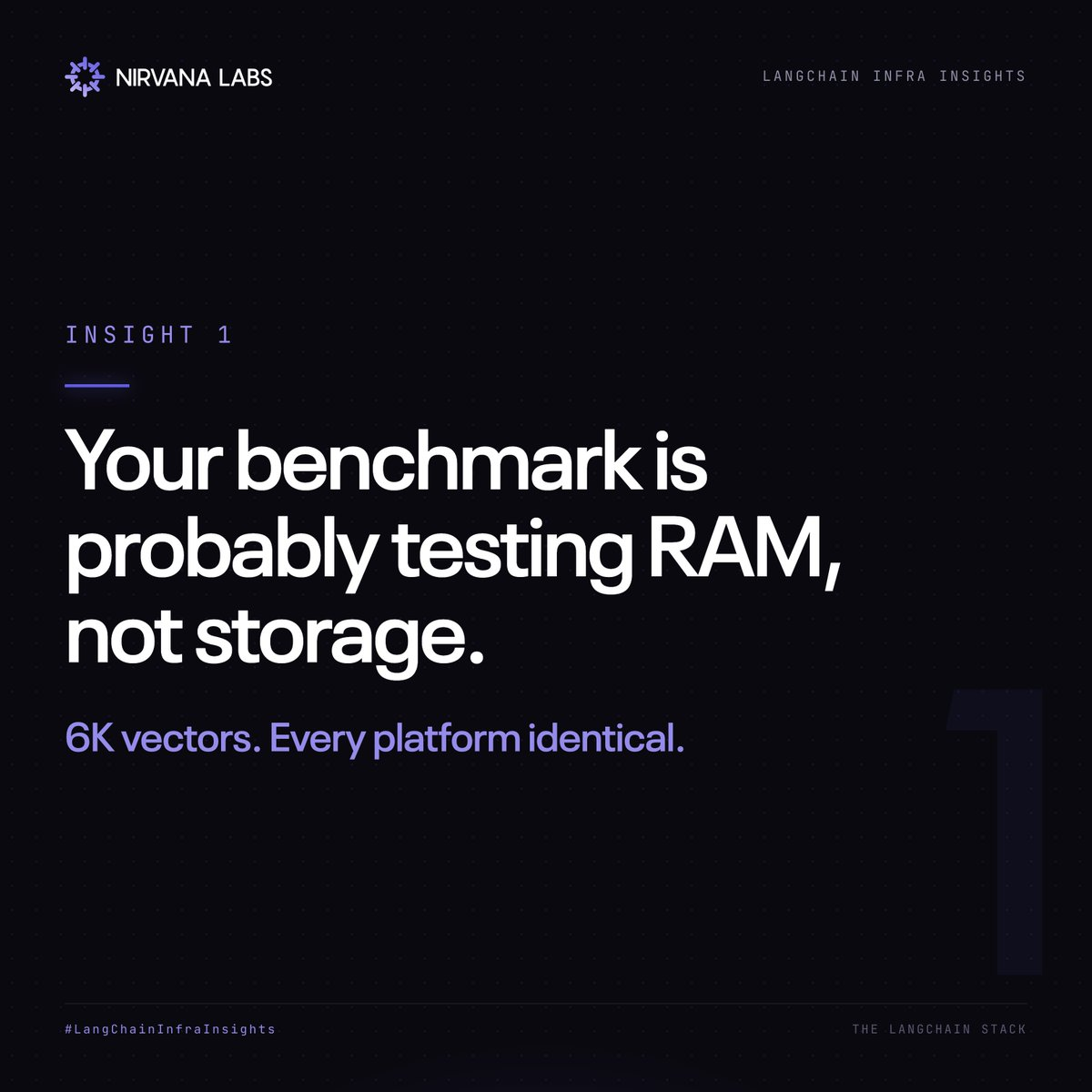
Benchmark insight #1: Most datasets are too small. We started at 6K vectors. The data fit in memory 400× over, so every platform looked identical — we were measuring caching, not storage. Cranked to 5M vectors (15 GB on 16 GB RAM) so it actually spills to disk. That's when the differences showed up.
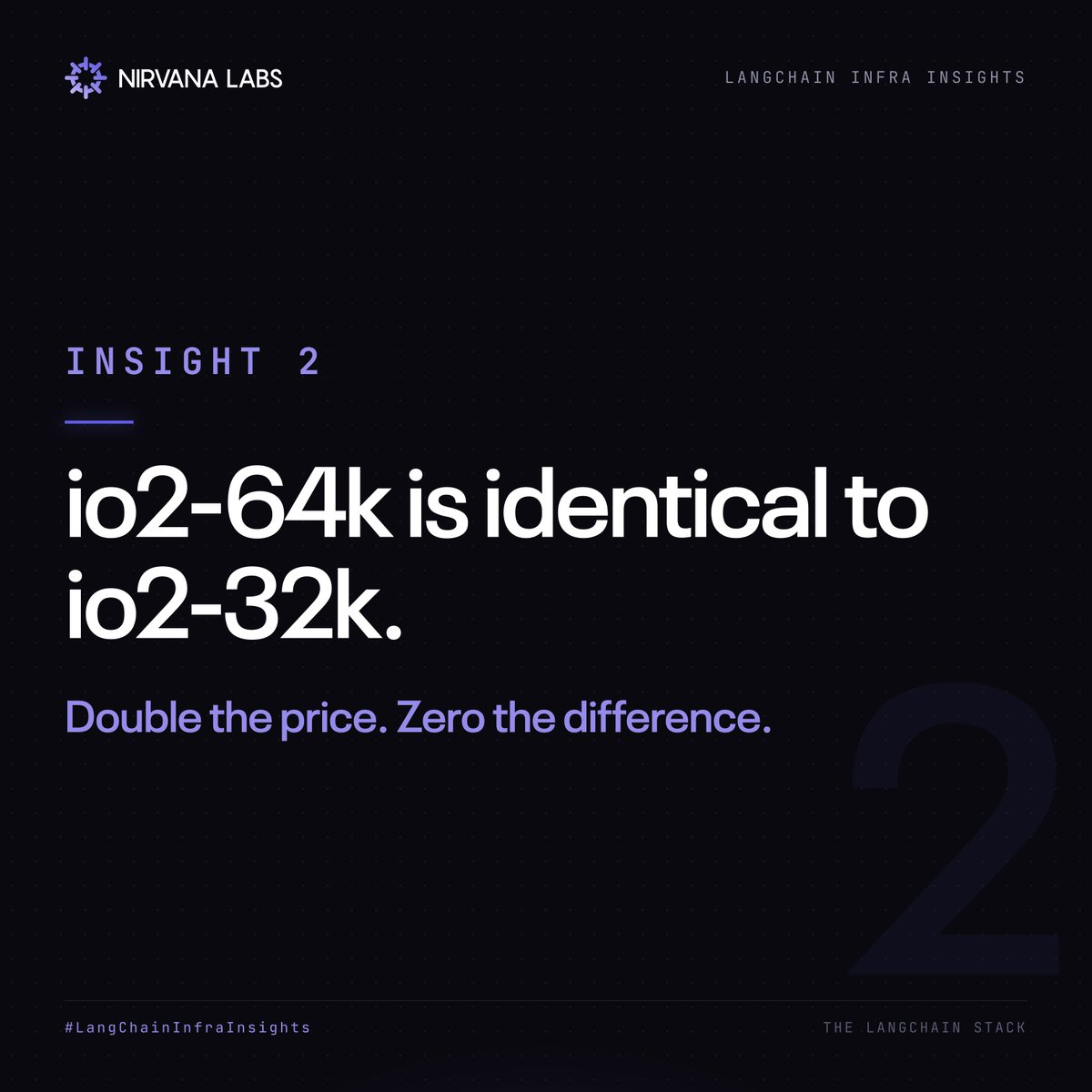
Benchmark insight #2: io2-64k is identical to io2-32k. We ran every scenario at both IOPS levels — 100×10, 500×20, 1000×100. The results were indistinguishable. The m6i.xlarge instance caps at ~40K actual IOPS, but io2-64k bills for 64K. You're paying more for nothing.
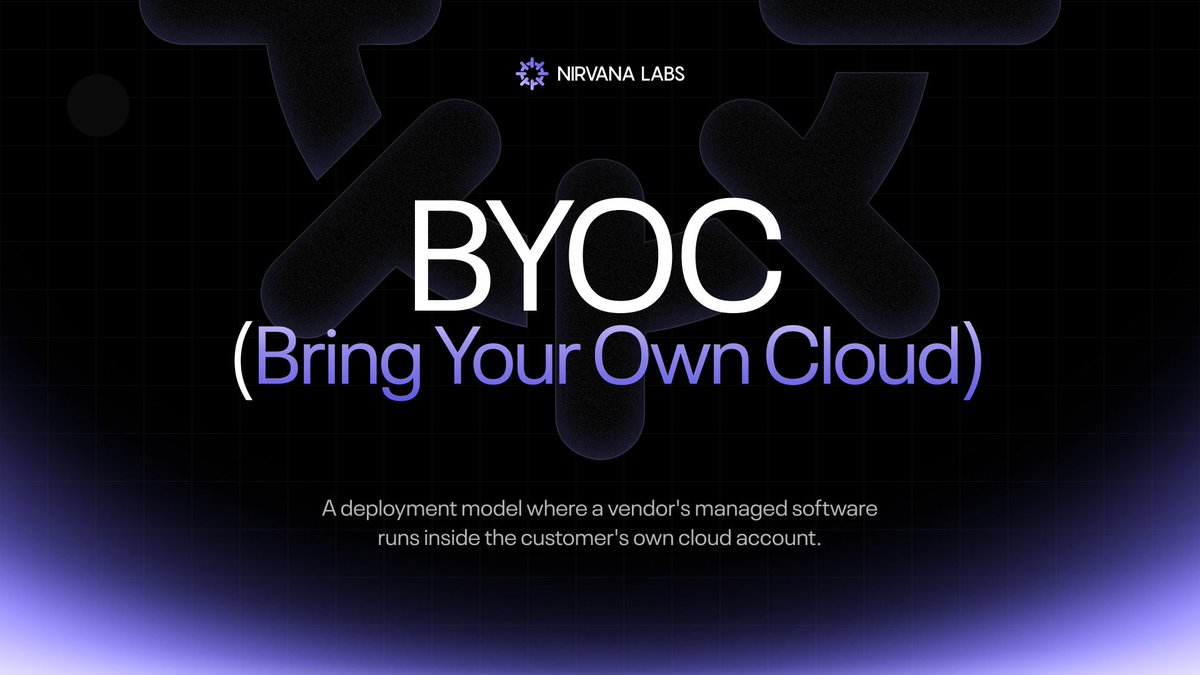
BYOC (Bring Your Own Cloud). A vendor's managed software runs inside your own cloud account. The win: your data never leaves, and the bill stays yours — managed expertise without giving up control. The catch: you inherit your cloud's limits too — IOPS-capped storage, egress fees. A great DB on a bad cloud is still bottlenecked.
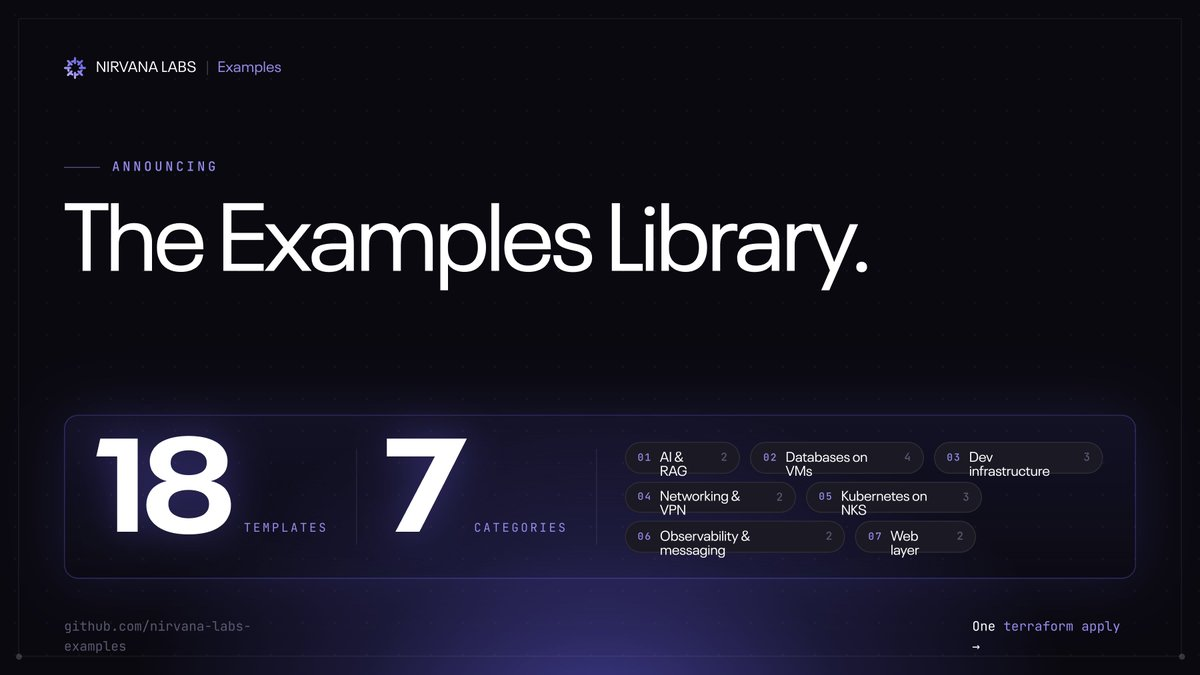
Examples Library, still live. Every repo is a working deployment. Real Terraform. Real Ansible. Same tools you use at work. No "click here to book a demo." Run → github.com/nirvana-labs-examples
ICYMI: What Is Nirvana
Nirvana is a high-performance block storage cloud, purpose-built for blockchain, AI, and databases.
- ABS — 20K baseline IOPS included, ultra-low latency
- NKS — managed Kubernetes with Karpenter autoscaling
- High-clock-speed compute and private networking
- Backed by Jump, Crucible, Castle Island, Raptor Group
- 50+ customers live in production today
More: https://x.com/nirvanalabsai/status/2068019658360598963?s=20
What's Next
We're shipping more LangChain insights — production-grade deep dives off the benchmark. More NKS examples are in the queue: ClickHouse, Redis, MongoDB, Postgres, LangChain agents. And we're rolling out new POC stories from teams running real-time and data-heavy systems.
Data never stops growing. Your cloud shouldn't slow it down.
About Nirvana Labs
Nirvana Labs is a high-performance storage cloud purpose built for blockchain, AI and databases i.e. the most demanding, real-time, stateful workloads. Accelerated Block Storage (ABS) offers 20K baseline IOPS included, no over provisioning. Nirvana Kubernetes Service (NKS) with Karpenter auto-scaling, high clock-speed compute and private networking. Backed by Jump Trading, Crucible, etc with 50+ customers live in production today.
Learn more at Nirvana Labs
Nirvana Cloud | Pricing | Blog | Docs | Changelog | LinkedIn |Twitter | Telegram| YouTube
Related Posts
Nirvana Labs September 2026 Recap
September at Nirvana: $250 signup credit, referrals, the Altinity meetup, a new POC, and guides to harnesses and long-running agents.
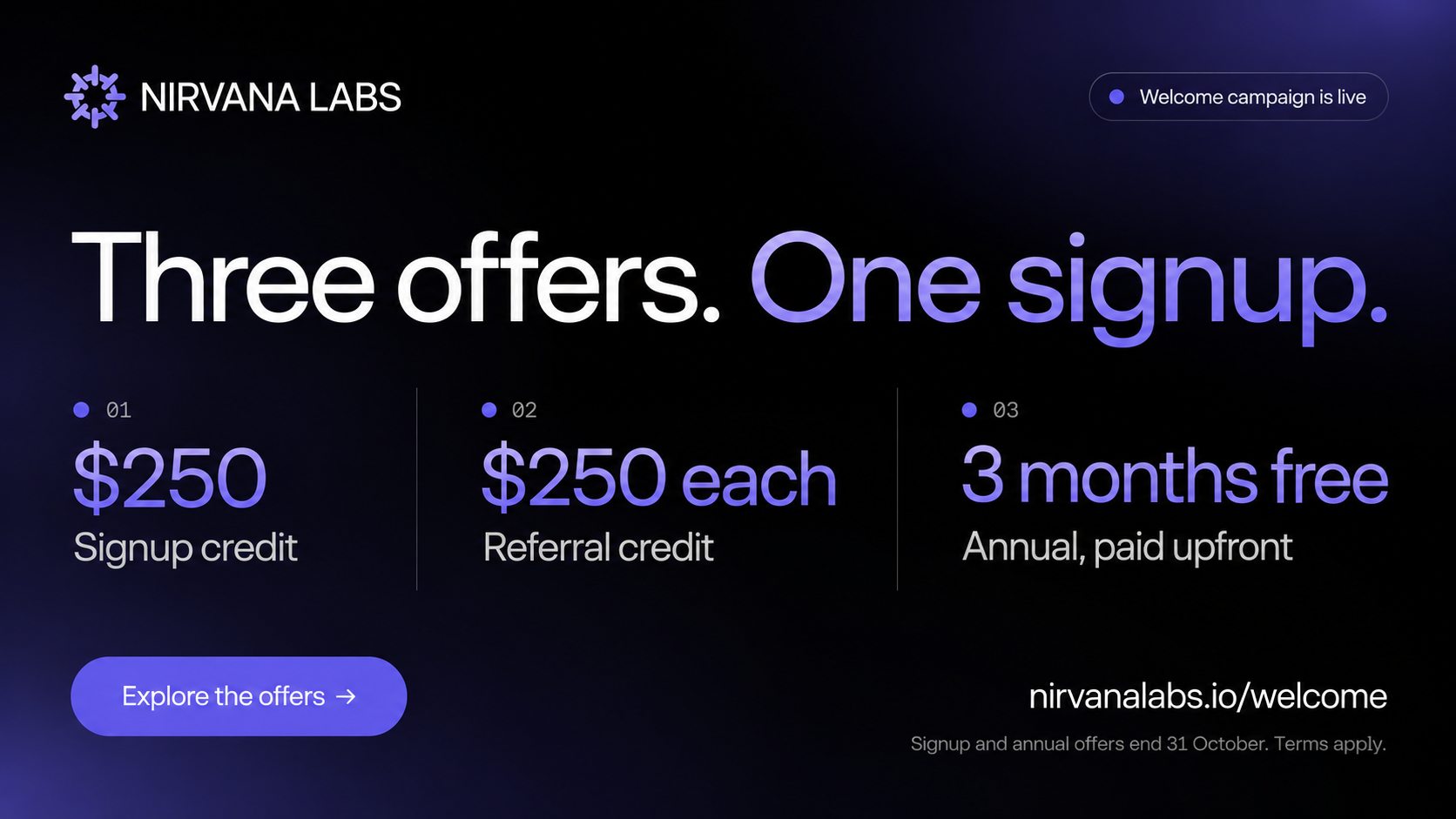
Nirvana Labs Welcome Campaign is Live.
$250 in credit to start. $250 each way when you refer a team. Two or three months free on annual. They stack.
Nirvana: The High Performance Storage Cloud
Why Nirvana is the High Performance Storage Cloud: purpose-built ABS with 20,000 sustained IOPS included, benchmarks against gp3 and io2, who runs on it, and what opens in Q4.
Powering AI, blockchain, and
databases
