
Fast, isolated, persistent agent sandboxes that make agent economics work.
Nirvana Agent Sandboxes are now available: fast, isolated environments for running autonomous agents at scale, with ephemeral and persistent options for different use cases. Priced 20% below mainstream managed sandbox providers, with infrastructure and orchestration on Nirvana's high-performance cloud.
Agents now run real code: installing packages, moving files, calling tools. That code is generated on the fly, so security teams want isolation rather than shared infrastructure. Every agent needs a sealed place to run, where a mistake or a malicious command reaches nothing else. That place is a sandbox: spun up fresh, worked in, torn down. Every provider gives you either fast, or isolated, and often with a premium for it. We built all three at once: fast, isolated, and economical.
Nirvana Agent Sandboxes: fast, isolated, persistent
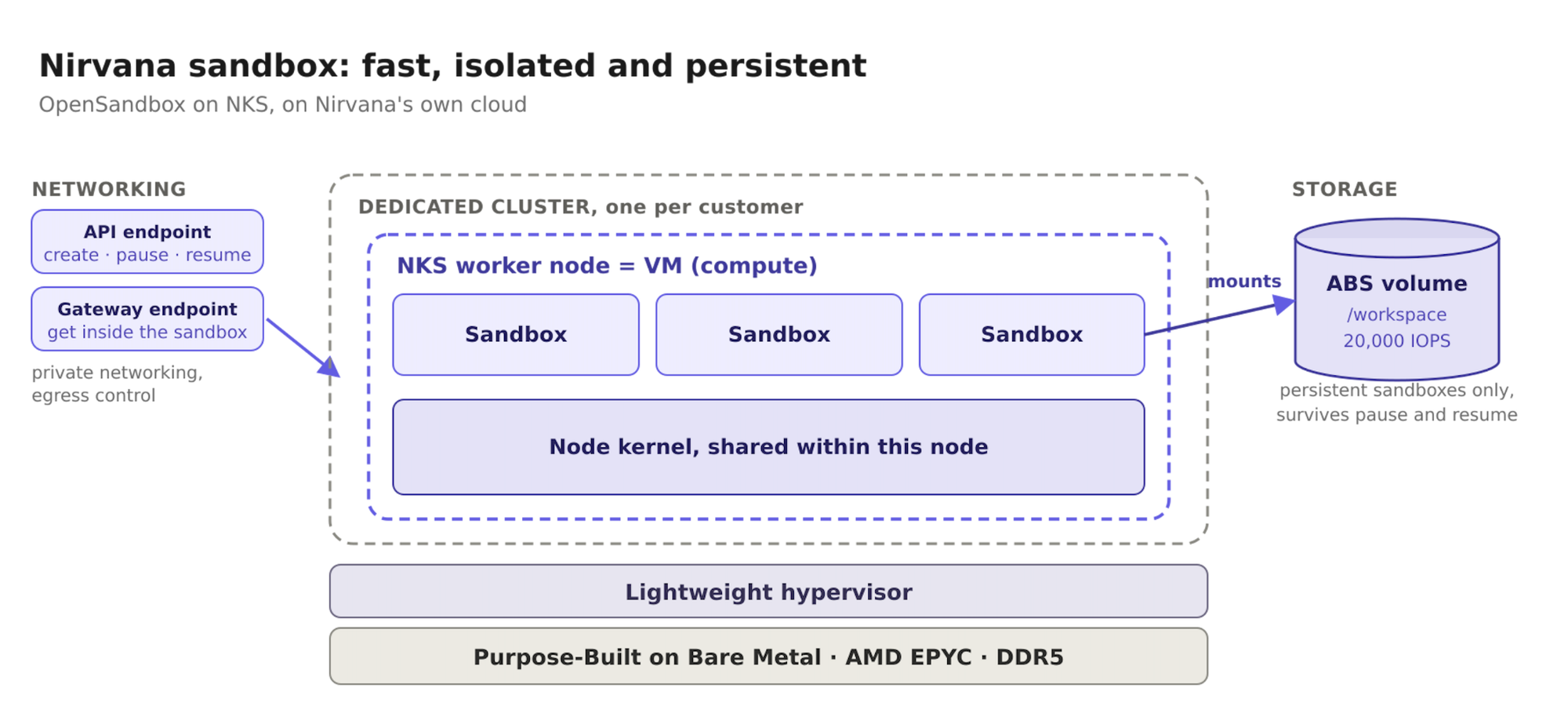
Nirvana Sandboxes run on Nirvana Kubernetes Service (NKS) worker nodes, and each node is a VM sealed by the lightweight hypervisor. Each sandbox is a hardened, unprivileged container. That gives you two boundaries: VM walls around the node, container walls around each sandbox. The result is the isolation of a VM without the usual shared-kernel trade-off: every customer gets a dedicated NKS cluster, managed by Nirvana, so your sandboxes never share a kernel, or anything else, with another company.
There are two sandbox options available:
Ephemeral sandboxes have no disk. Pure compute: boot in ~2.5s, run, and nothing is written or left behind on pause or when they stop.
Persistent sandboxes get a dedicated volume backed by our own Accelerated Block Storage (ABS) mounted at /workspace. First boot takes 6-7s, and everything the agent writes to /workspace survives pause and resume: pause instantly to stop paying for compute, resume instantly with every file exactly where it was. Verified end to end. ABS includes 20,000 sustained IOPS with no surcharge and no over-provisioning, so heavy read/write agent workloads run at full speed on the flat rate.
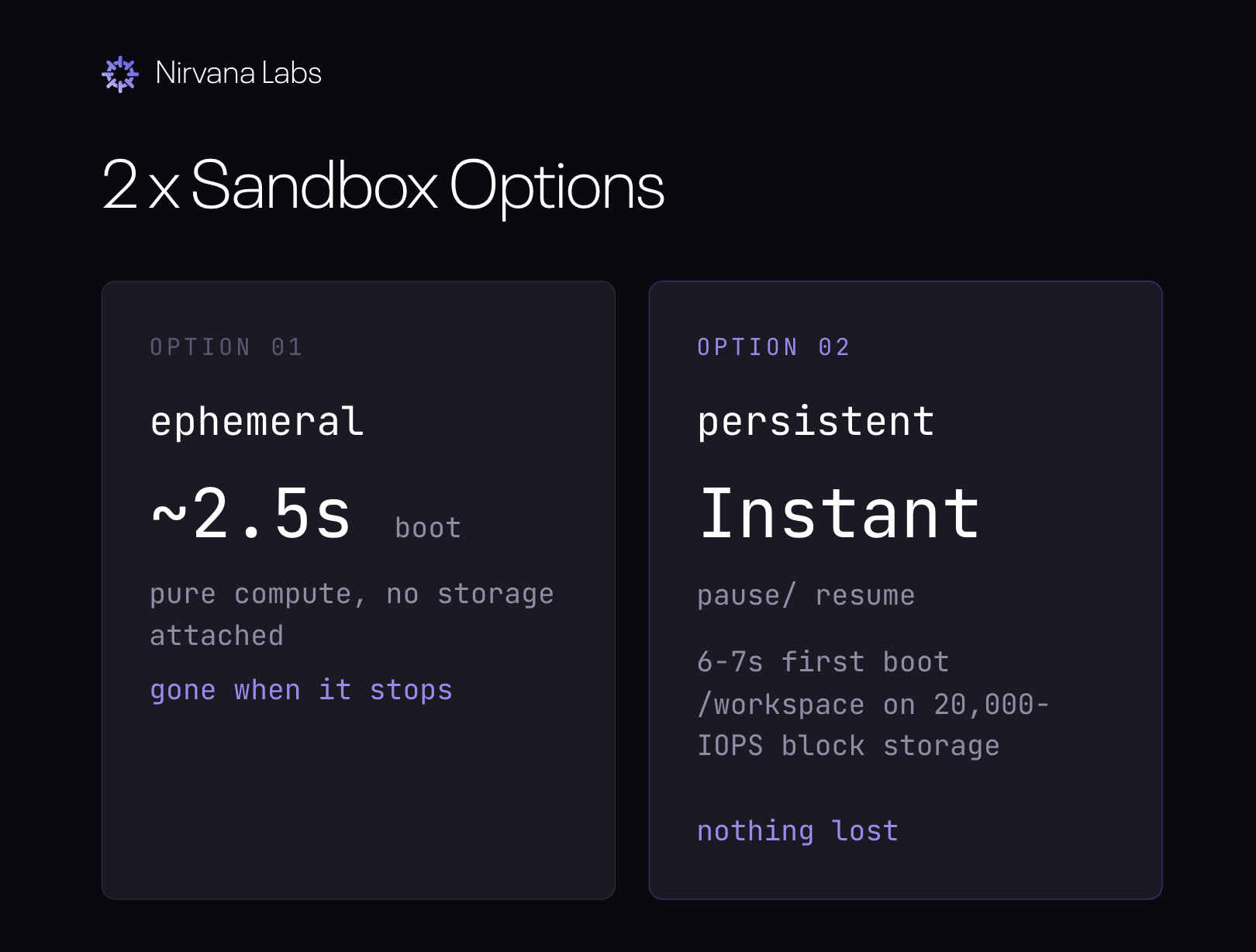
Rule of thumb: ephemeral for stateless jobs, persistent for long-running agents that need to checkpoint and continue.
A cloud, purpose-built for the workload
Instead of reselling a hyperscaler, Nirvana built its own: AMD EPYC 9354P CPUs, DDR5 RAM, a lightweight hypervisor, ABS for low-latency block storage, and hard anti-affinity, so a host can fail and the cluster keeps running with zero downtime - with orchestration (NKS) operated as one full-stack cloud.
The result: 20% below mainstream managed providers.
Get started
Nirvana Agent Sandboxes give every agent its own clean, isolated environment, while costs stay flat as you scale. For companies building agent products, Nirvana Sandboxes are the underlying substrate: agents run on them, with no infrastructure to manage.
Integration is simple: two endpoints and an API key, with SDKs in Python, TypeScript, Go, Java, Kotlin, and C#. Read the documentation for API examples, or talk to us to get an API key and endpoints for your team.
About Nirvana Labs
Nirvana Labs is a high-performance storage cloud purpose built for blockchain, AI and databases i.e. the most demanding, real-time, stateful workloads. Accelerated Block Storage (ABS) offers 20K baseline IOPS included, no over provisioning. Nirvana Kubernetes Service (NKS) with Karpenter auto-scaling, high clock-speed compute and private networking. Backed by Jump Trading, Crucible, etc with 50+ customers live in production today.
Learn more at Nirvana Labs
Nirvana Cloud | Pricing | Blog | Docs | Changelog | LinkedIn |Twitter | Telegram| YouTube
Related Posts
The expensive way to buy IOPS
If your storage bill is mostly meter, you paid the expensive way. Clouds price capacity cheap and meter IOPS on top: 60% of the bill at 20K IOPS, 84% at 80K, 91% on io2. Which workloads hit the meter, what it costs them, and whether yours should move.
Agent economics: the sandbox chapter
Storage-backed sandboxes save you twice: on idle, and on work you never redo. Fast disks. Persistent workspaces. Isolated sandboxes. And you pay for the work once. Run your agents on Nirvana.
Why Nirvana is the best place to run your AI agents
Nirvana is the best place to run your AI agents. Faster storage, a smaller bill, and more billable work out of the same agents.
Powering AI, blockchain, and
databases
