LangChain Agent Infrastructure Benchmark: Nirvana ABS vs AWS EBS
 April Wong
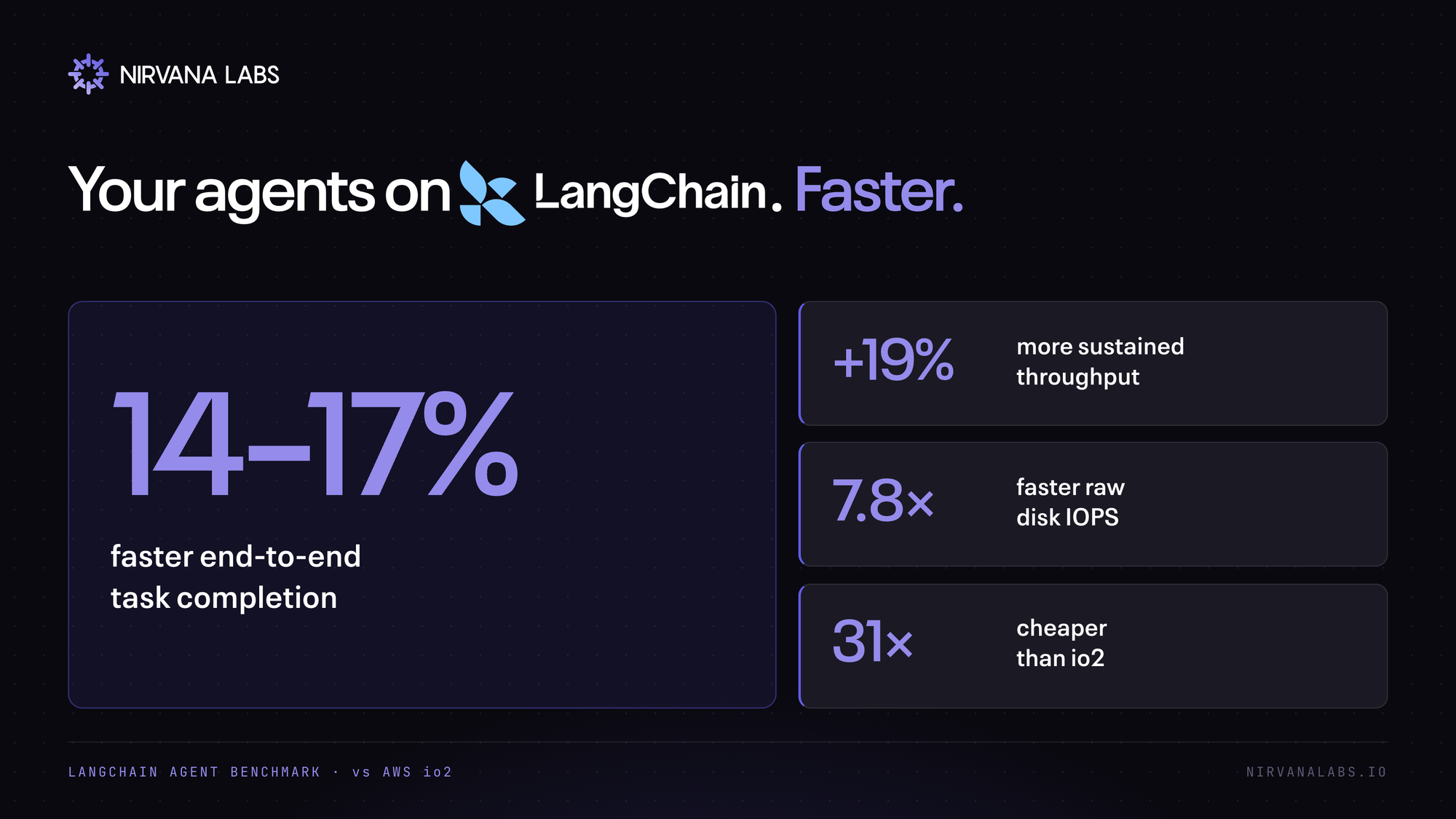
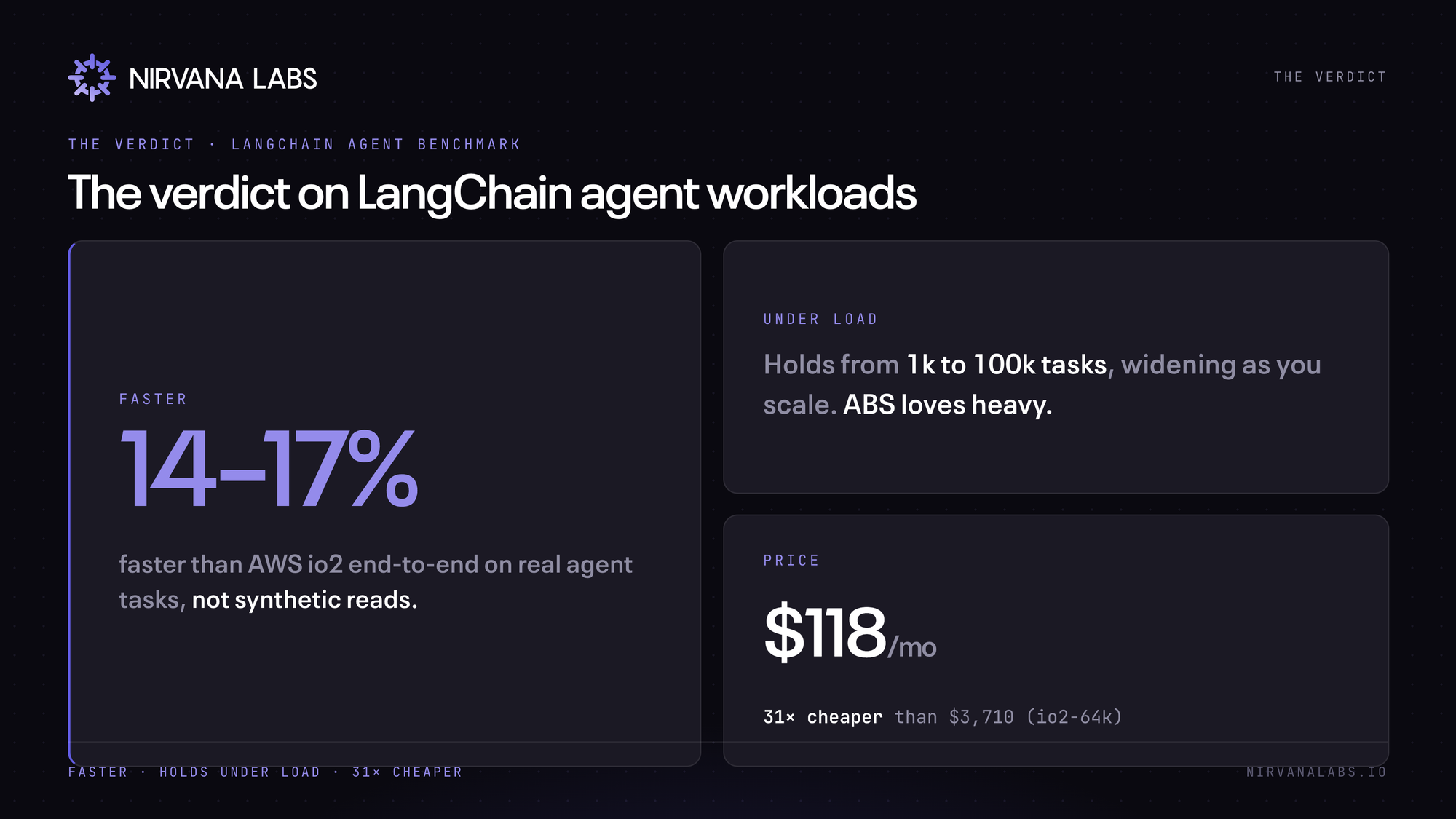
ABS finishes 14-17% faster than io2 at every scale, at 31x less cost.
TL;DR
- ABS finishes 14-17% faster than AWS io2 at every scale (1K, 10K, 100K tasks)
- +19% more throughput, 7.8x faster raw disk I/O
- 31x cheaper ($118/mo vs $3,710/mo for io2-64k)
- io2-64k performs identically to io2-32k (instance-capped at ~40K IOPS)
- io2-64k delivered lower Qdrant p99 (140 ms vs 301 ms); ABS completed the six-operation workload in 58 minutes vs 69 minutes.
- All cold reads, 3 runs per scenario, fully reproducible
In our previous post we broke down what LangChain is, how the ReAct loop works, and where each step hits the cloud. The takeaway: every time an agent "acts," the data and storage layer (Qdrant, Redis, Postgres) reads and writes to the disk on your VM. That's the one layer where cloud storage performance directly affects how fast agents finish work.
This post is the results. We ran identical LangChain agent workloads across five storage platforms to answer one question: does the disk underneath actually make a difference?
It does.
14-17% faster task completion than AWS io2. +19% more throughput. 7.8x faster raw disk. 19x cheaper.
The workload
5M vectors across 50 Qdrant collections. 100 to 1,000 concurrent LangChain agents. Each task hits 3 services: Qdrant for vector search, Redis for caching, Postgres for checkpoints. 6 storage ops per task. All cold reads. Page cache dropped before every run.
The setup
Same workload, same hardware, five storage tiers. The only variable is the block storage.
| Config | Instance | vCPU / RAM | Storage | Provisioned IOPS | Cost / mo |
|---|---|---|---|---|---|
| Nirvana ABS | n1-standard-4 | 4 / 16 GB DDR5 | ABS 256 GB | 20K baseline, 600K burst, included | $118 |
| gp3-3k | m6i.xlarge | 4 / 16 GB DDR4 | gp3 256 GB | 3,000 | $147 |
| gp3-16k | m6i.xlarge | 4 / 16 GB DDR4 | gp3 256 GB | 16,000 | $212 |
| io2-32k | m6i.xlarge | 4 / 16 GB DDR4 | io2 256 GB | 32,000 | $2,238 |
| io2-64k | m6i.xlarge | 4 / 16 GB DDR4 | io2 256 GB | 64,000 | $3,710 |
Held constant: instance class, 4 vCPU / 16 GB / 256 GB, same agent code and data on all five.
The only variable: the block storage. ABS includes 20,000 sustained IOPS in the base price. io2 is billed per provisioned IOPS.
Task completion at scale
ABS wins at every scale. The lead widens with load.
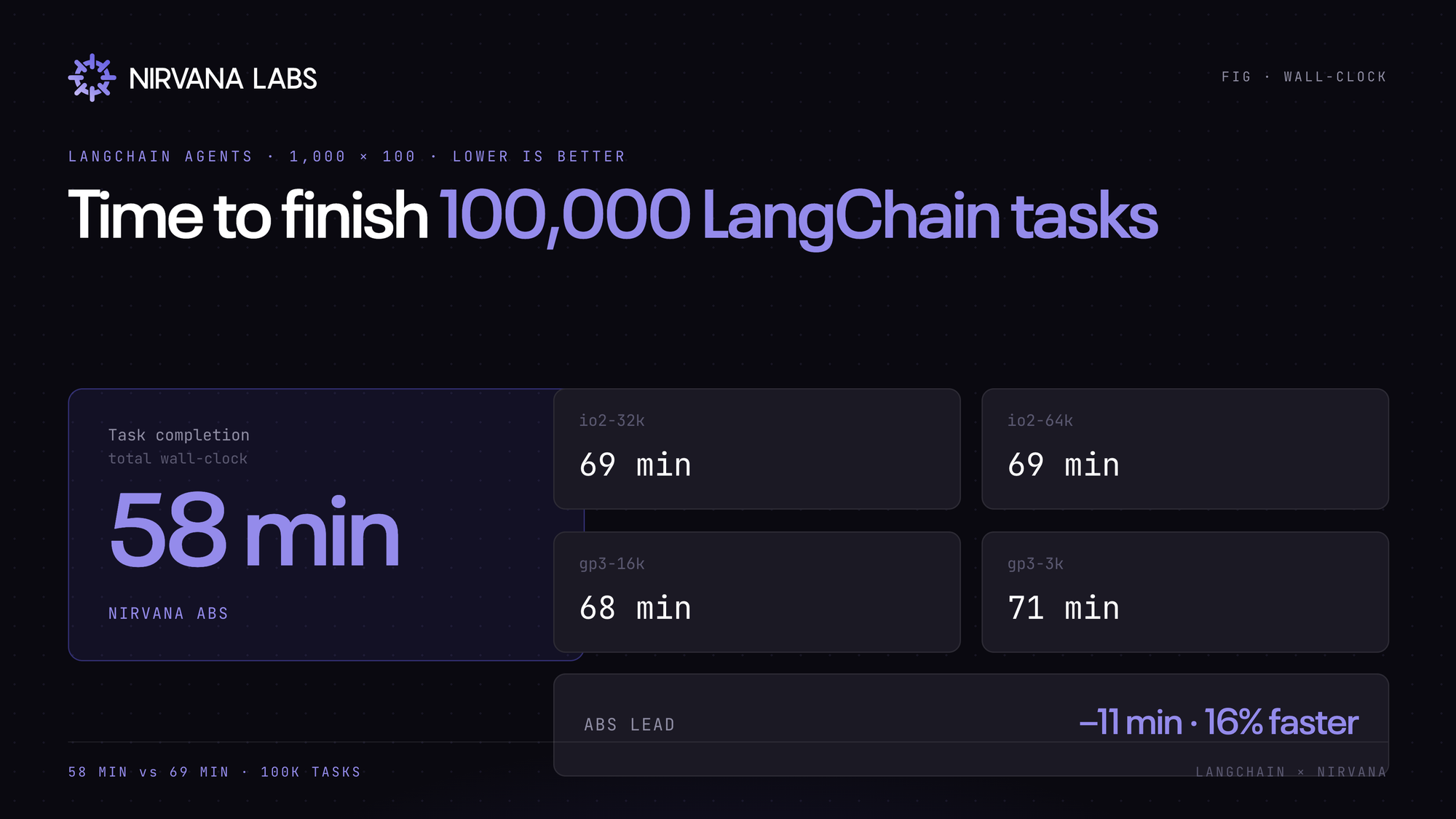
| Scale | Tasks | Nirvana ABS | io2-32k | io2-64k | gp3-16k | gp3-3k | ABS |
|---|---|---|---|---|---|---|---|
| 100x10 | 1,000 | 36s | 43s | 42s | 43s | 62s | 14-16% |
| 500x20 | 10,000 | 351s | 420s | 424s | 430s | 433s | 16-17% |
| 1000x100 | 100,000 | 58 min | 69 min | 69 min | 68 min | 71 min | 16% |
3 runs per scenario, all cold reads. Results reproduce across every run.
Task latency at 100K scale
| Platform | Task p50 | Task p95 | Task p99 |
|---|---|---|---|
| Nirvana ABS | 326 ms | 562 ms | 725 ms |
| io2-32k | 393 ms | 612 ms | 779 ms |
| io2-64k | 396 ms | 606 ms | 771 ms |
| gp3-16k | 390 ms | 605 ms | 760 ms |
| gp3-3k | 404 ms | 643 ms | 809 ms |
Per-service breakdown at 100K tasks
Each task chains 6 ops across 3 services. Here's where each platform wins and loses.
| Service | Per task | ABS p99 | io2-64k p99 | ABS vs io2 |
|---|---|---|---|---|
| Qdrant (vector search) | 2 ops | 301 ms | 140 ms | io2 leads |
| Redis (cache) | 2 ops | 68.0 ms | 70.4 ms | ABS 3% faster |
| Postgres (checkpoints) | 2 ops | 31.9 ms | 37.7 ms | ABS 15% faster |
| Task p99 (compound) | 6 ops | 725 ms | 771 ms | ABS 6% faster |
| Task completion | 100K tasks | 58 min | 69 min | ABS 16% faster |
io2 wins one metric: per-query Qdrant p99. ABS wins Redis p99, Postgres p99, task p99, and task completion.
These results describe different layers. io2-64k was materially faster on per-query Qdrant p99. ABS led Redis p99, PostgreSQL p99, compound task p99 and total workload completion in this test. The mixed result does not establish Nirvana as the fastest vector-search infrastructure.
The full workload completed sooner on ABS, while io2 remained faster on Qdrant query latency.
Cost
Prices shown are the benchmark's historical monthly configuration at the time of testing; verify current pricing separately.
| Platform | Monthly cost |
|---|---|
| Nirvana ABS | $118 |
| gp3-3k | $147 |
| gp3-16k | $212 |
| io2-32k | $2,238 |
| io2-64k | $3,710 |
ABS finishes faster than every AWS tier at a fraction of the cost. io2-64k performs identically to io2-32k on this instance class. The m6i.xlarge instance caps IOPS at ~40K regardless of what you provision.
Verdict
If you're running concurrent agent workloads: ABS. Fastest task completion at every scale we tested, at 19x less than io2.
Open source. Run it yourself.
We built this benchmark because nobody else did. LangChain has 138K stars and zero infrastructure benchmarks. Now there's one, and it's open source.
Open source. Run it yourself.
Full report: nirvanalabs.io/benchmark-results
Repo: github.com/nirvana-labs-examples/langchain-benchmarks
Terraform configs, Ansible playbooks, benchmark runner, raw JSON results.
Add your own storage config and compare.
About Nirvana Labs
Nirvana Labs is a high-performance storage cloud purpose built for blockchain, AI and databases i.e. the most demanding, real-time, stateful workloads. Accelerated Block Storage (ABS) offers 20K baseline IOPS included, no over provisioning. Nirvana Kubernetes Service (NKS) with Karpenter auto-scaling, high clock-speed compute and private networking. Backed by Jump Trading, Crucible, etc with 50+ customers live in production today.
Learn more at Nirvana Labs
Nirvana Cloud | Pricing | Blog | Docs | Changelog | LinkedIn |Twitter | Telegram| YouTube
Related Posts
Build or Buy a Secure Code Interpreter Backend for AI Agents?
Decide who should operate your AI code execution backend, with clear security boundaries, durable-state requirements and an application acceptance test.
How to Choose Cloud Infrastructure for a Vector Database
Choose vector infrastructure by query latency, recall and concurrency. Nirvana completed its mixed agent benchmark sooner, while io2 delivered lower Qdrant p99.
Which Cloud Is Best for Long-Running AI Agents?
Choose agent hosting by the work it preserves. Compare persistence, recovery, operating models and cost, with clearly scoped Nirvana benchmark evidence.
Powering AI, blockchain, and
databases
