Altinity × Nirvana: The joint stack behind the hot data for ClickHouse®
 April Wong
Who runs what, from your dashboard down to the disk, and why the answer keeps ClickHouse® data always hot.
TL;DR:
- Nirvana is now a BYOC option on Altinity.Cloud: Altinity's managed service for ClickHouse® running on Nirvana's high-performance storage cloud, GA now
- One boundary organizes the stack: Altinity runs everything on NKS (clusters, operator, console, support); Nirvana runs NKS and everything beneath it (compute, ABS, networking)
- ABS ships 20,000 baseline sustained IOPS included, vs AWS gp3's default 3,000, with no per-IOP surcharges
- Best case: your workload also runs on Nirvana, putting database and application on the same rack with $0 internal egress
- Proven before GA: SSB selective queries at 34-63 ms against 3 billion rows, ~70M rows/sec sustained scans, stable run to run
ClickHouse® performance depends on two broad layers: how the database is designed and operated, and the infrastructure beneath it. This partnership brings together specialists in each: Altinity and Nirvana.
Altinity is the largest independent managed service provider for ClickHouse®, working with the database since 2017. It already supports BYOC deployments across AWS, GCP, Azure, and Hetzner to allow users the flexibility of bringing their own cloud. Nirvana, a high-performance storage cloud, serves production blockchain, AI, database, and other stateful workloads, with Accelerated Block Storage (ABS) and Nirvana Kubernetes Service (NKS), both launched in 2026.
The partnership places Altinity's managed service for ClickHouse layer directly on Nirvana's infrastructure. Here is how the joint stack works together to provide always hot ClickHouse data.
Joint stack architecture overview
Nirvana is now a BYOC option on Altinity.Cloud, meaning Altinity runs its managed service for ClickHouse on Nirvana cloud, backed by ABS block storage: 20,000 baseline sustained IOPS included (vs AWS gp3 default 3000 IOPS), no over-provisioning needed. The best scenario is when the customer's application also runs on Nirvana: the database and workload can then be placed on the same rack, for a shorter application-to-database path and $0 internal egress between them. The stack splits into three domains of responsibility.
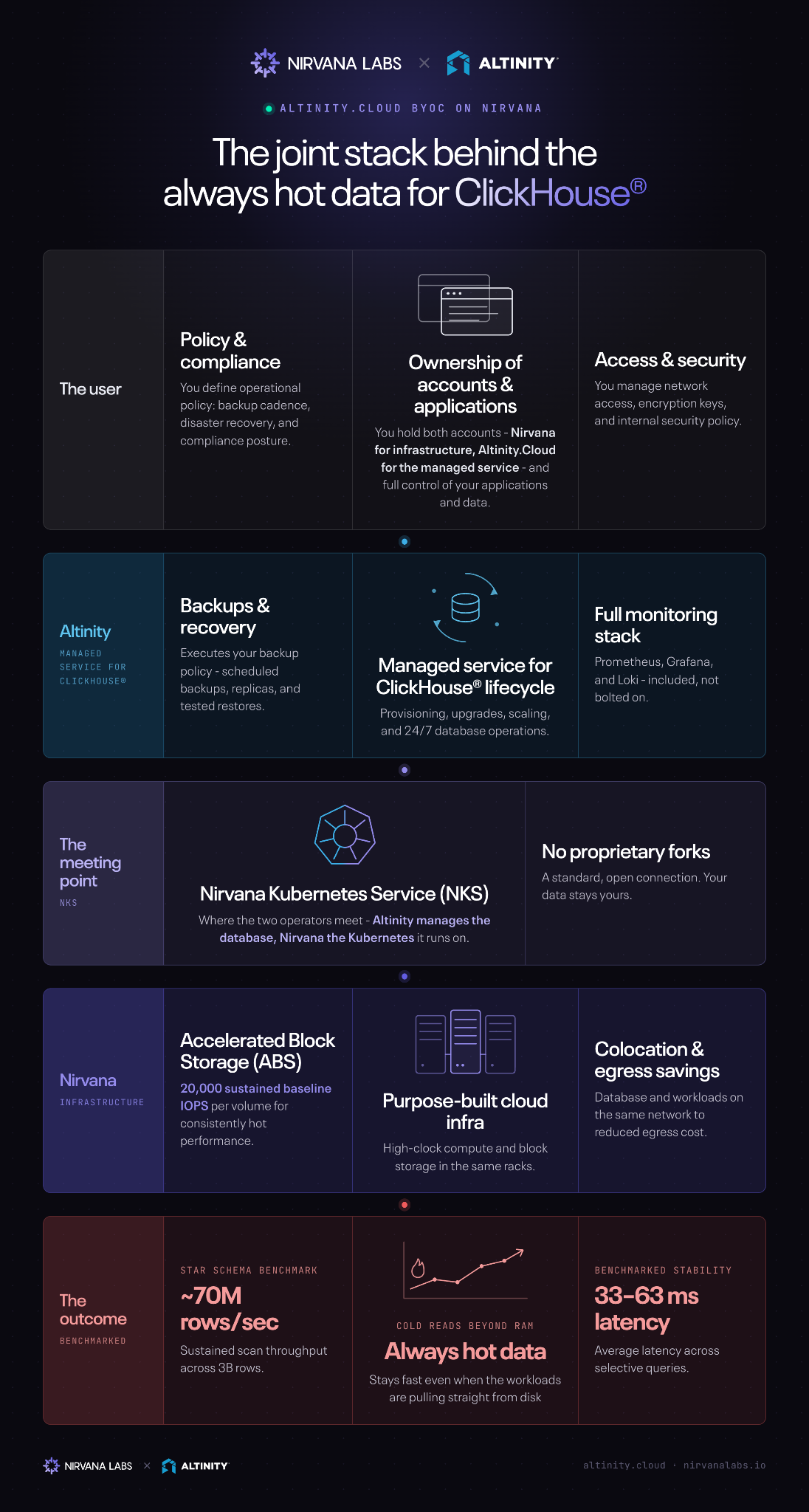
You control:
- Your applications, workloads, and data: the pipelines, dashboards, APIs, and business logic above the database
- Your Altinity & Nirvana account, project-scoped API-key permissions, access policies, and operational requirements
- Your topology choices: compute shape, storage size, shards and replicas, and the Altinity support tier
- The backup, availability, and disaster-recovery outcomes the deployment must meet
Altinity manages (the managed service for ClickHouse® layer):
- ClickHouse® clusters: automated cluster creation, upgrades, rescaling, and monitoring
- The NKS environment required by Altinity.Cloud: provisioning and configuration of the service resources, deployment of the ClickHouse stack, and monitoring from the service layer
- Service-side networking: provisioning and configuration of the network resources and database access paths within the customer's Nirvana project, according to customer-defined policies
- The Altinity Kubernetes Operator and Altinity Cloud Manager console, with monitoring through the open-source stack of Prometheus, Grafana, and Loki
- Database access controls: users, roles, permissions, allowlists, and access tokens, administered according to customer-defined policies
- Schema and query support: Altinity's ClickHouse® engineers assist with cluster design, schema design, query optimization, and advice on scaling production systems
- Backups and operational support: automatic backups with on-demand restore of a full cluster or single tables, and support from 8×5 to 24/7 coverage with SLA-backed response times, according to the selected service plan. High availability and disaster recovery remain shared responsibilities: Altinity provides the mechanisms, while the customer defines the required outcomes and settings
Nirvana operates (the infrastructure layer):
- The managed NKS platform and control plane: Kubernetes lifecycle operations, upgrades and maintenance, plus Karpenter-based worker-node autoscaling
- New compute model: dedicated VMs on high-clock AMD EPYC processors
- ABS block storage: 20,000 baseline sustained IOPS included, with burst performance up to 600,000 IOPS and sub-millisecond latency. No burst credits, separate performance metering, or per-IOP surcharges
- Networking: private VPCs with firewall rules, same-rack placement when the customer's workload also runs on Nirvana
Altinity runs everything on NKS; Nirvana runs NKS and everything beneath it. That way, the infrastructure under ClickHouse comes from a vertically integrated provider whose storage, compute, and networking are designed and benchmarked together for stateful, performance-sensitive workloads. And because the two teams built and benchmarked this integration together, a performance question that crosses the boundary lands in an engineering relationship, not a support ticket between strangers.
Proven before GA
Before this partnership was announced, Altinity benchmarked the stack on Nirvana to make sure the product held up, then proved it with a production client. Only then did Nirvana become a provisioning option in Altinity's documentation, alongside AWS, GCP, Azure, and Hetzner.
The results of that proving-out are public: on the joint stack, SSB selective queries answered in 34-63 ms against a 3-billion-row table, full scans sustained ~70M rows/sec from disk, and repeat runs landed within a few percent of each other (full report).
And the integration itself is evidence: getting on the joint stack is five steps in the Altinity console, with one project-scoped API key. When two companies wire their products together properly, the seam is small enough to fit in a quickstart guide.
Try it
Start with a 14-day Altinity.Cloud trial and pick Nirvana Labs as your BYOC infrastructure option. Or bring your dataset and queries, and we will benchmark them on the same infrastructure used for the published reports: Talk to us →
About Nirvana Labs
Nirvana Labs is a high-performance storage cloud purpose built for blockchain, AI and databases i.e. the most demanding, real-time, stateful workloads. Accelerated Block Storage (ABS) offers 20K baseline IOPS included, no over provisioning. Nirvana Kubernetes Service (NKS) with Karpenter auto-scaling, high clock-speed compute and private networking. Backed by Jump Trading, Crucible, etc with 50+ customers live in production today.
Learn more at Nirvana Labs
Nirvana Cloud | Pricing | Blog | Docs | Changelog | LinkedIn | Twitter | Telegram | YouTube
Related Posts
The expensive way to buy IOPS
If your storage bill is mostly meter, you paid the expensive way. Clouds price capacity cheap and meter IOPS on top: 60% of the bill at 20K IOPS, 84% at 80K, 91% on io2. Which workloads hit the meter, what it costs them, and whether yours should move.
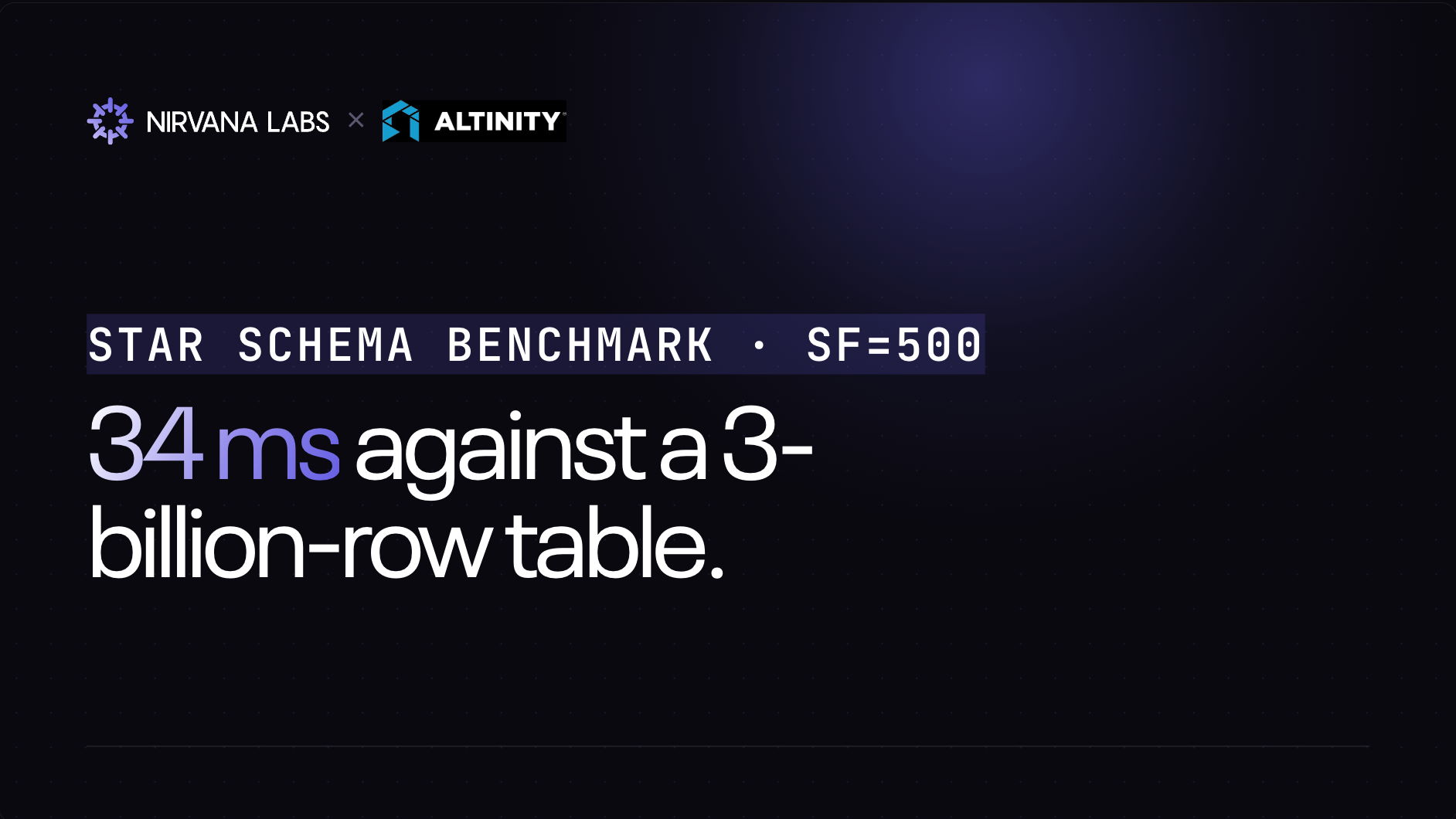
Star Schema Benchmark: ClickHouse® on Nirvana × Altinity
Star Schema Benchmark: ClickHouse® on Nirvana × Altinity: 34 ms selective queries against a 3-billion-row table. ~70M rows/sec sustained on full scans from disk.
Nirvana × Altinity BYOC Partnership
Nirvana Labs (Nirvana), a high performance storage cloud, is announcing a strategic partnership between Nirvana and Altinity, the largest independent managed service provider for ClickHouse®. The integration is now generally available as a Bring Your Own Cloud (BYOC) deployment on Altinity.Cloud.
Powering AI, blockchain, and
databases
