
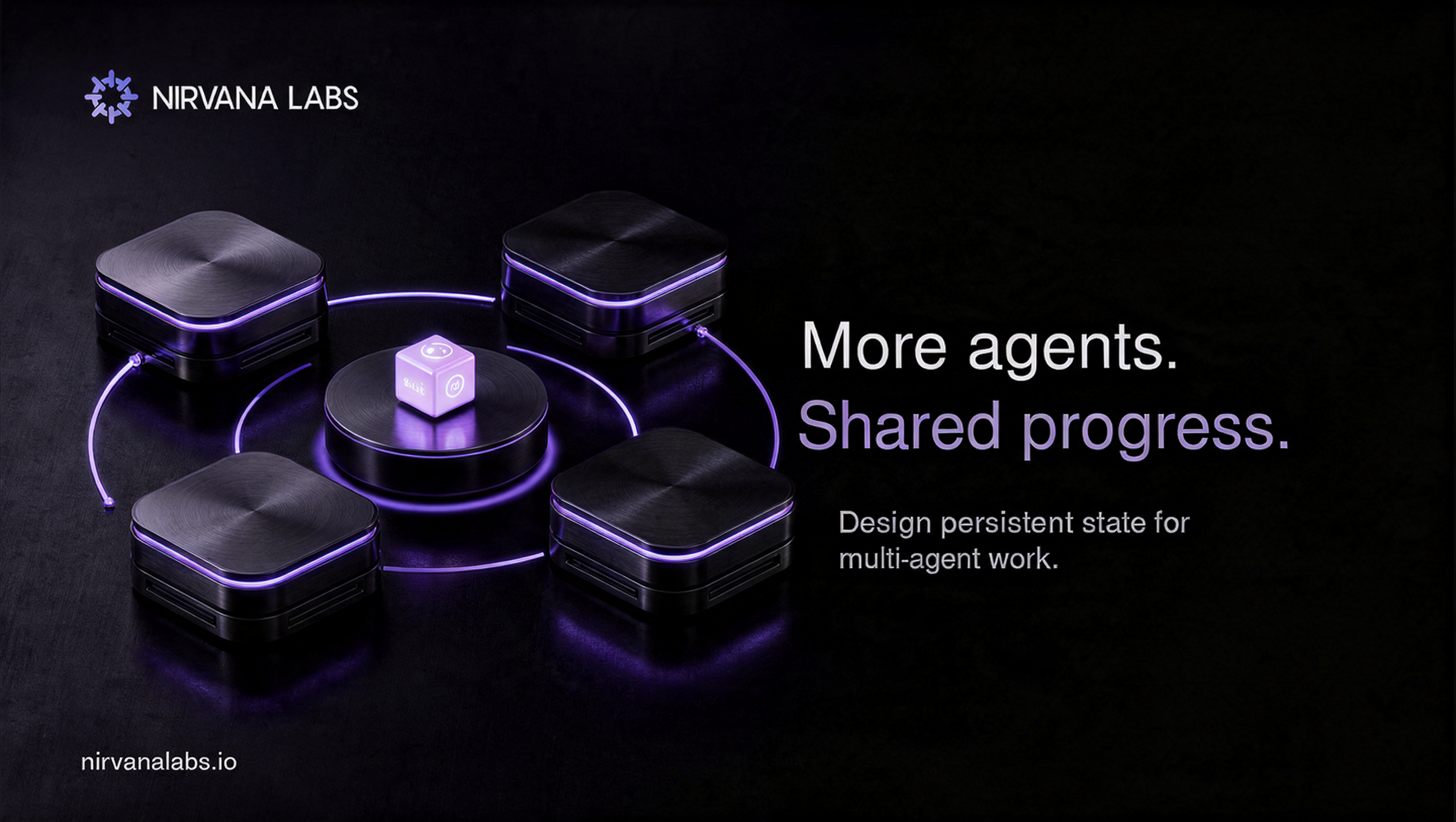
One agent drafts a report. Another checks its sources. A third publishes the approved result. Giving all three the same folder sounds simple until two update the same file, one restarts, or the publisher reads an unfinished version.
Short answer: keep each agent’s working files separate, use a durable coordination store for shared records, and hand off versioned artifacts with explicit ownership. Persistent storage preserves bytes. Your application must also define which agent may change them and how conflicting updates are resolved.
TL;DR
- Separate private workspace files, thread checkpoints, shared facts and published artifacts.
- Use transactions or conditional updates for shared task ownership and state transitions.
- Identify every artifact by a stable ID and version, rather than a filename alone.
- Test worker restarts, concurrent claims, stale writers and tenant isolation.
- A persistent sandbox does not automatically provide a shared filesystem or concurrency control.
Which state needs to be shared?
Start with a state inventory. Sharing everything creates unnecessary coupling; sharing too little forces workers to repeat completed work.
| State | Typical home | Ownership rule |
|---|---|---|
| Scratch files and dependencies | Agent-specific workspace | One worker owns its changes |
| Execution checkpoint | Persistent framework checkpointer | Scope by tenant and execution thread |
| Task status and artifact manifest | Transactional database or equivalent coordination service | Guard state transitions against concurrent writers |
| Completed output | Versioned artifact storage | Publish immutable versions; update the reference deliberately |
| Cross-run knowledge | Application-defined store | Define who may read, update and delete each namespace |
LangGraph makes a related distinction between thread-scoped checkpoints and cross-thread stores. An in-memory implementation is useful for development, but its contents disappear when that process restarts. A production persistence choice needs an explicit recovery path.
Why not mount one disk into every agent?
A shared filesystem can be appropriate when the workload and storage system support it. It does not, by itself, decide whether two updates are compatible. Your application still needs locking, version checks or an equivalent coordination mechanism.
Kubernetes access modes describe how a volume can be mounted. ReadWriteOnce means read-write mounting by one node, and can still allow multiple pods on that node. ReadWriteOncePod restricts access to one pod for supported CSI volumes. These are different from a database transaction or an application’s tenant boundary.
Before choosing shared mounts, verify the driver, filesystem, access mode and deployment topology. Do not infer multi-writer support from the fact that a workspace survives a restart.
A practical handoff: researcher to reviewer to publisher
Consider an illustrative content pipeline. The researcher owns a private workspace and writes a draft artifact. On completion, it creates an immutable artifact version and records its ID, checksum and source list in the shared task record. The reviewer reads that version, writes a separate review artifact, and marks the task ready only when its checks pass. The publisher acts on the approved version, not whichever file was modified most recently.
A useful task record includes tenant_id, task_id, status, owner, lease_until, version and artifact_id. These are proposed application fields, not a Nirvana API schema.
When claiming a task, make the ownership update conditional on its current state and version. If two workers compete, only one should receive the successful claim. PostgreSQL provides row-level locking as one building block. Keep database transactions short and handle retries; do not hold a lock across a long model call.
Leases help abandoned work become available again, but an expired lease does not stop a slow worker from writing. Pair the lease with a version or fencing token that the write path checks. Reject an old worker’s update after another worker takes ownership.
What happens when an agent restarts?
Restart recovery should answer three questions: which task does this worker own, which artifact version is authoritative, and which external actions have already happened? Reconstruct those answers from durable records rather than process memory.
For external effects such as sending a message or publishing a page, use a stable operation identifier and reconcile uncertain outcomes. Shared storage cannot make an external service call exactly-once by itself. Our agent recovery guide covers that separate retry problem.
How does this fit Nirvana Agent Sandboxes?
Nirvana’s persistence documentation describes an optional PVC-backed /workspace retained across pause and resume. It distinguishes development-oriented local-path storage from the abs class for production workloads. Your agent must write and reload the state it needs.
Use that workspace for the worker’s files, then choose a coordination service and artifact store appropriate to your application. The documentation reviewed here does not establish that one sandbox workspace can be concurrently mounted by an arbitrary number of other sandboxes.
What should you test before increasing concurrency?
- Have two workers claim the same task and verify that only one succeeds.
- Stop the owner after writing an artifact but before updating task status; recover without losing or publishing the wrong version.
- Let a lease expire, assign a new owner, then confirm the stale worker cannot overwrite its result.
- Retry the handoff and verify that artifact identity and downstream action identity stay stable.
- Attempt cross-tenant reads using test accounts and verify the intended access boundary.
Measure correctness first, then completed tasks per minute, coordination latency and recovery time. These are proposed acceptance tests, not results from a completed Nirvana benchmark.
Frequently asked questions
Is a checkpoint the same as shared memory?
No. A checkpoint typically represents one execution’s progress. Shared application knowledge needs a scope and update policy that works across executions.
Does faster storage solve conflicting writes?
No. Faster I/O can reduce waiting, but conflicting writes still need an application-level consistency strategy.
Can every agent keep a separate workspace?
Yes. Separate working directories with explicit artifact handoffs are often a useful starting design. Whether they fit depends on how much concurrent file sharing the workload actually requires.
Explore Nirvana Agent Sandboxes and the long-running agent infrastructure guide when evaluating your execution and persistence layers.
Primary documentation reviewed 20 October 2026.
About Nirvana Labs
Nirvana Labs is a high-performance storage cloud built for blockchain, AI and databases: demanding, real-time, stateful workloads. Its high-performance block storage, compute, private networking, Nirvana Kubernetes Service and Agent Sandboxes help teams build and operate data-intensive applications.
Learn more at Nirvana Labs.
Nirvana Cloud | Pricing | Blog | Docs | Changelog | LinkedIn | Twitter | Telegram | YouTube
Related Posts
Why Database p99 Latency Spikes During Backups and Checkpoints
Diagnose database latency during maintenance with a controlled mixed-load test. Separate storage contention, checkpoint work, CPU pressure and client queueing.
Kubernetes Volume Snapshots vs Backups: What Your Database Needs
Compare snapshots and database backups by consistency, failure domain, retention and restore results. Includes a practical Kubernetes recovery acceptance test.
How to Manage Cloud Infrastructure With Your AI Assistant Through MCP
Connect your assistant to the Nirvana API through MCP, start with read-only discovery, and verify infrastructure changes with a practical acceptance checklist.
Powering AI, blockchain, and
databases
