
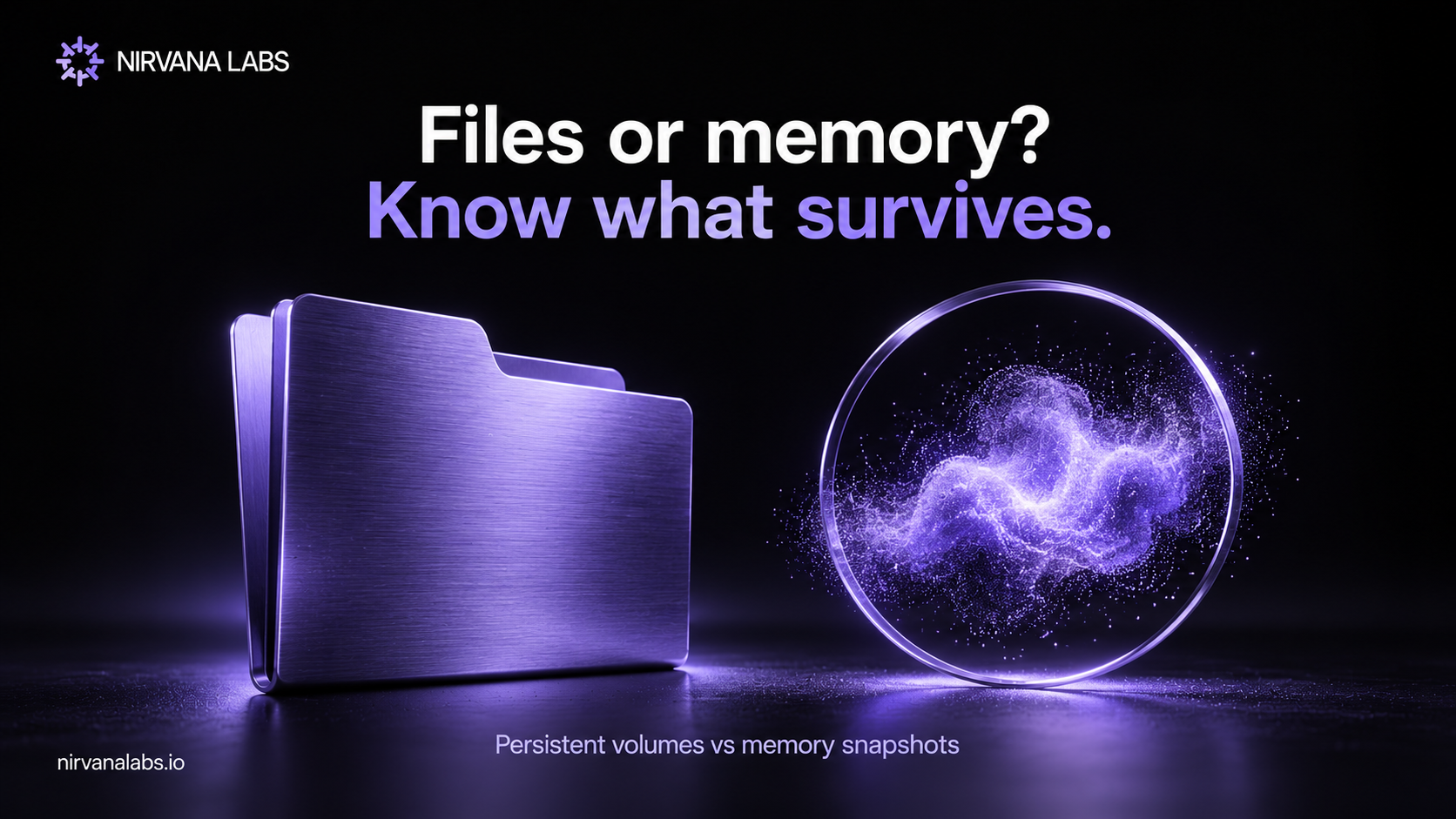
An agent finishes a tool call, writes a report and waits for a user. Hours later, the worker is gone. What does “resume” need to recover: the report, the Python process, the conversation state, or confirmation that the tool call already happened?
TL;DR
- Persistent volumes retain written files; memory snapshots preserve supported process state; checkpoints record where work can safely continue.
- Store progress durably and version the checkpoint so a restarted worker can validate its inputs and artifacts.
- Restoring memory does not undo an external action. Use stable operation IDs and reconcile uncertain outcomes before retrying.
- Test crashes, expired credentials, competing workers and software upgrades—not only a successful planned pause.
These are separate kinds of state. A persistent volume retains written data. A memory snapshot captures process state within its supported environment. An application checkpoint records where the workflow can safely continue. Most reliable agent designs need an explicit answer for all three, even when one infrastructure feature makes recovery convenient.
Documentation reviewed 7 October 2026. The examples are design and test scenarios, not reported benchmark results.
What survives in each recovery model?
| State | Persistent workspace volume | Memory snapshot | Application checkpoint |
|---|---|---|---|
| Saved repository and generated files | Yes, when written to the retained mount | Only as covered by that snapshot's filesystem contract | Usually references files rather than containing all of them |
| Loaded variables and interpreter heap | No | Potentially, within the provider's supported restore path | Only values explicitly serialized |
| Running background process | Restart it | May be restored, subject to limitations | Record how to recreate it |
| Completed external API action | Does not establish whether it happened | Does not roll the external service back | Can record the operation ID and confirmation |
| Recovery across software versions | Depends on file-format compatibility | Often constrained by the captured environment | Can be designed with an explicit schema version |
The table is an architectural comparison, not a promise that every product implements each column identically. Read the lifecycle documentation for the selected mode. For example, E2B's filesystem-only option keeps disk state but reboots on restoration; it also has different auto-resume behavior from a full memory snapshot.
On Nirvana, persistent sandbox storage retains the /workspace PVC while pause removes the pod. Resume creates a new pod using that workspace. The application must restart and load saved progress; the old process is not being continued from RAM.
Where should an agent put its durable progress?
Separate artifacts from workflow decisions. Artifacts include downloaded inputs, generated files and repository changes. Workflow decisions include which step completed, which input version it used and which external operation was accepted. A directory full of outputs does not always tell a restarted worker whether the next step is safe.
Consider a research agent that downloads sources, builds an index and uploads a report. A useful checkpoint might look like this illustrative record:
{
  "schema_version": 1,
  "job_id": "research-042",
  "input_revision": "sources-v3",
  "completed_step": "build_index",
  "next_step": "write_report",
  "artifact_manifest": "artifacts-v3.json",
  "external_operation_id": null
}
The important fields are the relationships. The checkpoint names the input revision and artifact manifest so recovery can detect mismatched files. It records a completed boundary rather than a vague percentage. A schema version gives future code a chance to reject or migrate incompatible state deliberately.
Keep the checkpoint in storage that actually survives the failure you are addressing. LangGraph's persistence documentation states that its in-memory savers lose checkpoints on process restart and points to persistent backends. Calling an object a checkpointer does not make RAM durable.
For multiple writers, decide who owns the job. Two restored workers reading the same “next step” can both act. A durable lease, conditional state update or database transaction can coordinate ownership; which mechanism fits depends on the application's storage and failure model.
When is a memory snapshot worth the additional dependency?
Memory restoration is attractive when rebuilding live state is expensive or awkward: a large interpreter session, an initialized environment or an interactive process that users expect to continue. Measure the initialization work it saves against capture time, retained-state cost and restore constraints.
It is less compelling when the application already restarts quickly from a small checkpoint. In that case, preserving an entire process may make software upgrades and debugging harder without materially improving the user experience. An explicit restart can also make initialization behavior easier to test.
Provider limitations matter. Modal's sandbox snapshot documentation labels memory snapshots Alpha, describes a seven-day lifetime and documents restrictions including external TCP reconnection and instance-type compatibility. These are reasons to test the exact restore path, not evidence that all memory snapshots share those limits.
Daytona likewise distinguishes filesystem persistence from VM memory persistence. Choose a lifecycle operation whose semantics match the state you need. Product-level labels such as “persistent” conceal this choice.
External reality keeps moving while the agent is paused. Credentials may expire, a remote job may finish and another user may change a document. Restoring memory should therefore be followed by revalidation of the dependencies that matter to the next action. The process's old view of the world is not automatically current.
How do you prevent duplicate actions after recovery?
Imagine the report upload succeeds, but the worker stops before saving “upload complete.” After recovery, the checkpoint still says to upload. Both a volume-backed restart and a memory restore can encounter this ambiguity at the boundary between local state and a remote service.
Use an operation identifier that remains stable across retries. If the destination supports idempotency keys, reuse the same key for the same logical action. Otherwise, query the destination for a reliable completion marker before repeating the operation, or route uncertain cases for reconciliation. Do not generate a new operation ID simply because the worker restarted.
Where the checkpoint and business update share a transactional database, consider recording them in the same transaction. When they span systems, document the intermediate states and recovery procedure. A snapshot is not a distributed transaction coordinator.
The same reasoning applies to agent forks. Two copies of a workspace can be useful for exploration, but they should not both believe they own permission to publish the same final result. Give each branch an identity and require an explicit handoff before a shared external action.
What should a recovery test prove?
Create a fixture with one saved file, one memory-only token, one durable checkpoint and one harmless external operation in a test service. Run planned pause, process restart and restore into a fresh environment as separate tests. Record which state each case is expected to preserve before running it.
| Test | Evidence to collect | Failure it can reveal |
|---|---|---|
| Restart after a completed checkpoint | Checkpoint version, file hashes, next step | State written to an ephemeral path |
| Stop after remote success but before local confirmation | Destination operation ID and retry count | Duplicate side effects |
| Restore after credentials expire | Reauthentication outcome | Stale assumptions carried in RAM |
| Start two workers for one job | Ownership decisions and accepted writes | Concurrent execution of the same step |
| Restore with a newer application version | Compatibility decision | Silent misreading of old state |
Record time to correct useful work, not just the time until the runtime answers. Also verify the oldest acceptable checkpoint and the backup path. A retained live volume can still contain a mistaken deletion; persistence alone does not provide historical recovery.
For a restartable design, begin with Nirvana's persistence configuration. Put durable files on the retained mount, make checkpoint loading part of startup and test the complete recovery sequence before depending on it.
FAQ
Is a memory snapshot a backup?
It may preserve a recovery point, but retention, deletion, failure isolation and restore validation still need an explicit backup design.
Does a persistent volume preserve a running Python process?
No. It preserves written data. A new process must load that data unless a separate supported mechanism restores memory.
Can I use both approaches?
Yes. A durable application checkpoint can provide a recovery boundary while memory restoration improves the normal resume experience. Test the fallback path as well as the fast path.
About Nirvana Labs
Nirvana Labs is a high-performance storage cloud purpose built for blockchain, AI and databases i.e. the most demanding, real-time, stateful workloads. Accelerated Block Storage (ABS) offers 20K baseline IOPS included, no over provisioning. Nirvana Kubernetes Service (NKS) with Karpenter auto-scaling, high clock-speed compute and private networking. Backed by Jump Trading, Crucible, etc with 50+ customers live in production today.
Learn more at Nirvana Labs
Nirvana Cloud | Pricing | Blog | Docs | Changelog | LinkedIn | Twitter | Telegram | YouTube
Related Posts
How to Benchmark PostgreSQL WAL and Commit Performance on Cloud Storage
A repeatable PostgreSQL storage evaluation: control durability settings, separate transaction and commit latency, inspect WAL and checkpoint metrics, and test recovery.
How to Test Redis AOF Rewrites and Recovery Before Production
A practical acceptance test for Redis persistence: measure rewrites under load, validate acknowledged writes after failure, and prove independent backup recovery.

Altinity.Cloud BYOC: An Evaluation and Migration Guide
Evaluate Altinity.Cloud BYOC for ClickHouse® with ownership, workload, backup and migration checks before a reversible cutover.
Powering AI, blockchain, and
databases
