
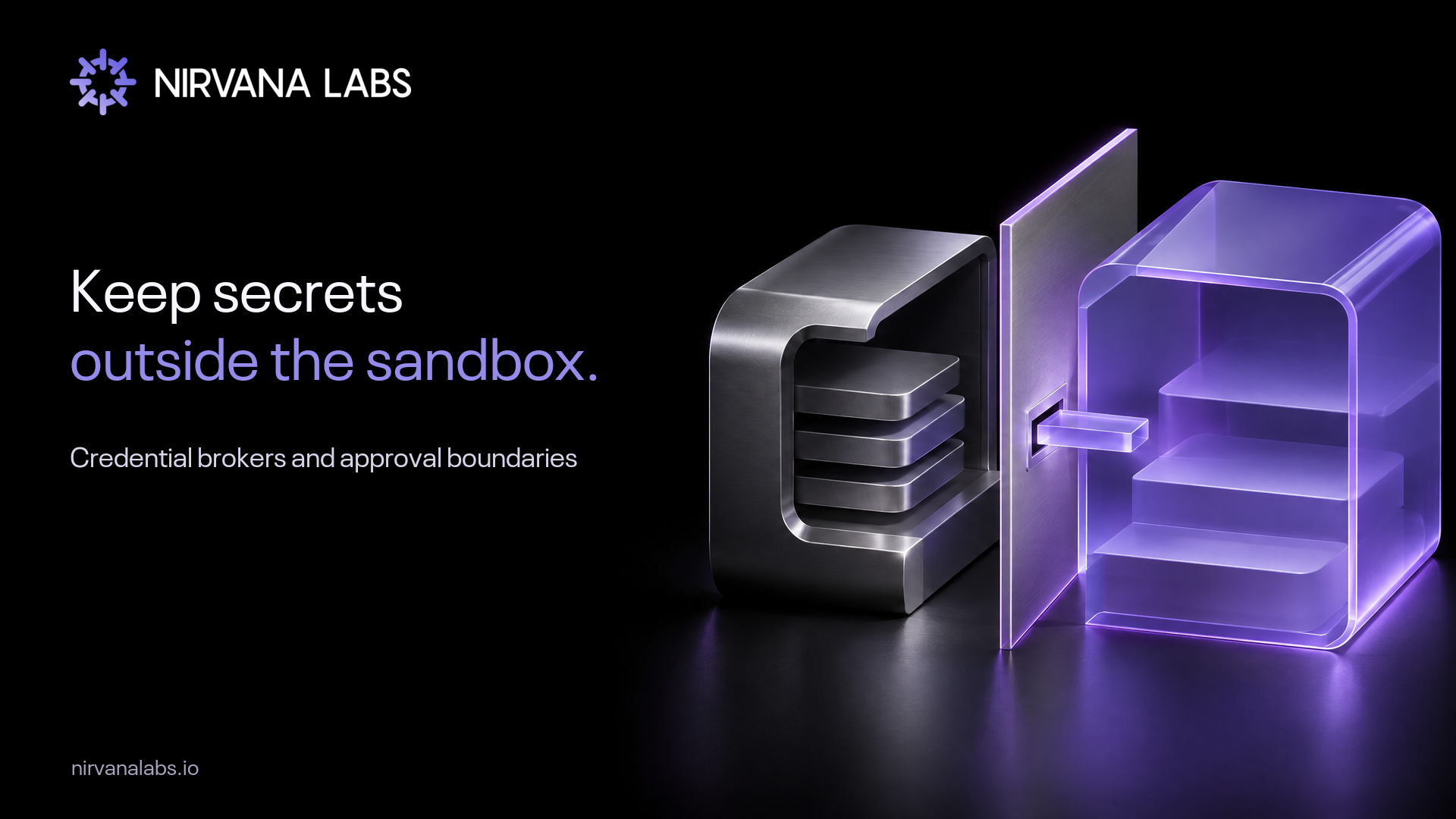
An AI coding sandbox should not receive a broad production key just because its task needs one authenticated request. Keep durable credentials in a trusted service outside the code-execution environment, then authorize narrowly defined operations through a credential broker or purpose-built tool. Combine that separation with runtime isolation and restricted outbound access. Hiding a key is useful, but it does not stop an agent from misusing an operation the key still authorizes.
This guide explains that design decision, rather than repeating the broader sandbox access-testing checklist. Documentation reviewed on 18 November 2026. The example is a proposed architecture, not a measured security result or a Nirvana feature announcement.
TL;DR
- Keep infrastructure control keys and durable service credentials outside agent-controlled processes.
- A broker must authorize the user, task, destination and operation, not merely replace a placeholder with a secret.
- Runtime isolation, network restrictions and downstream permissions address different failure modes.
- Test denied requests, revocation and broker outages with synthetic credentials before using real data.
Why isn't an environment variable a sufficient secret boundary?
Environment variables avoid hard-coding credentials into source, but code running in that environment may still read them. The same applies to credentials cached by developer tools, retained in workspace files or printed by diagnostics. A coding agent that installs dependencies and executes tests is not equivalent to a fixed application whose code you have already reviewed.
NVIDIA's AI Red Team guidance recommends keeping secrets outside the agent's execution environment and using narrowly scoped, short-lived access when needed. Its findings also show why network controls alone do not protect a secret that can appear in an agent's ordinary output.
The practical question is therefore not just “where is the key stored?” It is “which processes can read it, and what can those processes do with its authority?” Put the service that holds the real credential on the trusted side of that boundary.
What should a credential broker actually authorize?
A credential broker sits between the requesting workload and a protected service. It can attach authentication to approved outbound requests or perform a narrowly defined operation itself. The sandbox receives a restricted interface rather than the underlying long-lived key.
OpenSandbox's Credential Vault guide describes one implementation: an egress sidecar holds credentials, while sandbox tools use placeholder values. Request bindings constrain where authentication is injected. The upstream 1.2.1 release, dated 13 November 2026, adds per-request Credential Vault Exchange. These are upstream capabilities, not proof that every OpenSandbox-compatible provider exposes them.
Consider a coding assistant that prepares a patch for a private repository. A useful access design separates its stages:
| Stage | Suggested authority | Deliberately excluded |
|---|---|---|
| Inspect | Read one approved repository revision | Other repositories and organization settings |
| Build and test | Retrieve dependencies through an approved mirror | Publishing packages or reading deployment secrets |
| Save output | Write the patch and test report under the task's artifact prefix | Overwriting another task's output |
| Propose change | Submit a reviewable change through a trusted tool | Merging, deploying or changing permissions |
This is a design example, not a provider configuration. Enforce repository and artifact scope in the receiving services too. A domain allowlist cannot distinguish two repositories served by the same host.
For consequential actions, require a separate approval that identifies the operation and target. OWASP's excessive-agency guidance recommends minimal functionality, least-privilege downstream identities and authorization outside the model. A hidden administrator key still grants excessive authority if the broker will use it for any request.
How do isolation and network access change the design?
Credential separation does not replace runtime isolation. Kubernetes explains that ordinary containers share the host kernel, while virtual machines and userspace-kernel approaches offer different isolation boundaries. Namespaces alone are not a complete answer for mutually untrusted workloads. Review the actual runtime and tenancy model in the Kubernetes multi-tenancy documentation, rather than treating “sandbox” as a security certification.
Network controls limit where requests can travel. Kubernetes NetworkPolicy operates primarily at the IP and port layer and requires an enforcing network plugin. HTTP methods, repository paths and business permissions need additional controls. A secure incoming preview endpoint also says nothing by itself about outbound access.
Choose one documented, tested egress design. OpenSandbox's credential implementation requires its enforcement mode and warns about incompatible transparent service-mesh interception. Do not combine proxies and assume each sees the same request. Check TLS handling, direct-IP routes and how credentials are bound to destinations. If the selected runtime cannot support the required broker safely, use a trusted application tool outside it instead of weakening the network policy.
What evidence should a preproduction test capture?
Use a disposable environment, synthetic credentials and endpoints you control. The goal is to test the proposed authority boundary without exposing production secrets or probing unrelated systems.
| Test | Expected evidence |
|---|---|
| Approved request | The authorized operation succeeds, with a task-correlated audit record |
| Same service, different target | A request for an unrelated repository or artifact prefix is denied |
| Different operation | A read-only task cannot write, delete or alter permissions |
| Unapproved destination | No credential is attached, and the egress policy prevents the connection where required |
| Revoked task | New authenticated operations stop after revocation, within the documented propagation bound |
| Broker unavailable | The task fails visibly instead of falling back to an embedded key or unrestricted route |
| Output inspection | The synthetic secret does not appear in command output, logs, error reports or retained files |
Record image and policy versions, caller identity, expected result, observed result and time for each case. A timeout is not a complete denial test unless the control endpoint was otherwise reachable. Check long-lived connections separately from new requests; revocation behavior may differ.
Also test the authority the broker grants without disclosing a secret. Can the agent upload an inappropriate artifact to an otherwise approved service? Can it request a destructive operation through a broad API path? Those failures need narrower service permissions or an approval gate, not better key redaction.
Define a release gate before the test: every required control needs evidence, an owner and a documented failure response. Keep “not tested” separate from “passed.” No checklist proves the absence of every vulnerability, and this guide does not claim a security assessment was performed.
What does this mean for Nirvana Agent Sandboxes today?
Nirvana's current Agent Sandboxes documentation describes isolated containers on managed sandbox clusters, organization API-key authorization and signed, expiring service endpoints. Keep the organization key in the trusted orchestrator, not in generated code.
The current API reference lists supported operations and explicitly excludes pause/resume and creating sandboxes from snapshots. OpenSandbox API compatibility does not establish support for its Credential Vault, every isolation backend or every upstream lifecycle feature. Confirm the exact egress, credential and runtime controls for your deployment before selecting them.
For persistent jobs, evaluate the workspace storage behavior alongside authorization. High performance block storage can retain useful files, but retained files must not become a repository for durable credentials. Start the evaluation with one real coding workflow and the evidence table above.
FAQ
Does a credential broker prevent prompt injection?
No. It can reduce credential exposure and limit permitted actions. Untrusted instructions can still influence the agent, so downstream authorization and approval boundaries remain necessary.
Is a short-lived token safe to give directly to generated code?
It reduces the duration of exposure, not the permissions available during that period. Prefer narrow scope and keep the token outside the runtime when the workflow supports it.
Can an allowlisted service still be misused?
Yes. A permitted destination may accept destructive operations or data uploads. Restrict the operation, resource and user context, not only the hostname.
Does Nirvana include OpenSandbox Credential Vault?
This article does not establish that support. Use Nirvana's current documentation and confirm your deployment's capabilities; upstream release notes alone are not a provider support statement.
About Nirvana Labs
Nirvana Labs is a high performance storage cloud built for blockchain, AI and databases: demanding, real-time, stateful workloads. Its high performance block storage, compute, private networking, Nirvana Kubernetes Service and Agent Sandboxes help teams build and operate data-intensive applications.
Learn more at Nirvana Labs.
Nirvana Cloud | Pricing | Blog | Docs | Changelog | LinkedIn | Twitter | Telegram | YouTube
Related Posts

ClickHouse® Storage Architecture: Hot Data, Object Storage and Merge Pressure
Choose a ClickHouse storage layout by separating authoritative data, the fast serving path and recovery. Test cache behavior, merges and failures together.
How to Choose a Cloud Region for Stateful Applications
Choose a cloud region by application latency, service availability, failure domains and recovery requirements. A practical evaluation for stateful workloads.
What Does a Kubernetes Database Operator Actually Manage?
Understand what Kubernetes database operators automate, what your team still owns, and how to evaluate backups, failover and upgrades before production.
Powering AI, blockchain, and
databases
