Nirvana Instance Types are live: Compute Families Built for Your Workload
 April Wong
TL;DR:
- 26 standardized instance types across 3 families — n1-highcpu, n1-standard, and n1-highmem
- Each family is optimized for a workload profile: general-purpose, memory-intensive, or compute-heavy
- Up to 37% cheaper than AWS on equivalent configs
- Available now on VMs and NKS
Today we're shipping standardized instance types on Nirvana. 26 types across 3 families, each designed around a specific workload pattern. Pick a family, pick a size, and deploy — on both VMs and Nirvana Kubernetes Service (NKS).
Three Families, Three Workload Profiles
All families follow a consistent naming scheme: {series}-{family}-{vcpus}. Teams coming from other cloud providers will find a familiar structure.
The N1 series runs on AMD EPYC 7513 processors (32 Core / 64 Threads, 3.25 - 3.8 GHz) and is available in three families:
n1-highcpu - 2 GB per vCPU
Built for compute-bound work. CI/CD pipelines, video encoding, cryptographic verification, blockchain validation — workloads where CPU cycles matter more than memory. Sizes range from n1-highcpu-2 (2 vCPU, 4 GB) to n1-highcpu-96 (96 vCPU, 192 GB).
n1-standard - 4 GB per vCPU
The general-purpose family. Web servers, application backends, relational databases, and microservice fleets. This is where most teams start. Sizes range from n1-standard-2 (2 vCPU, 8 GB) to n1-standard-192 (192 vCPU, 768 GB).
n1-highmem - 8 GB per vCPU
Memory-optimized for workloads that need large memory-to-CPU ratios. In-memory caches (Redis, Memcached), analytical databases (ClickHouse, DuckDB), blockchain archive nodes, and data warehousing. Sizes range from n1-highmem-2 (2 vCPU, 16 GB) to n1-highmem-96 (96 vCPU, 768 GB).
Cloud Equivalents and Pricing
The families and memory ratios map to GCP and AWS — if you're migrating from either platform, you already know which family you need.
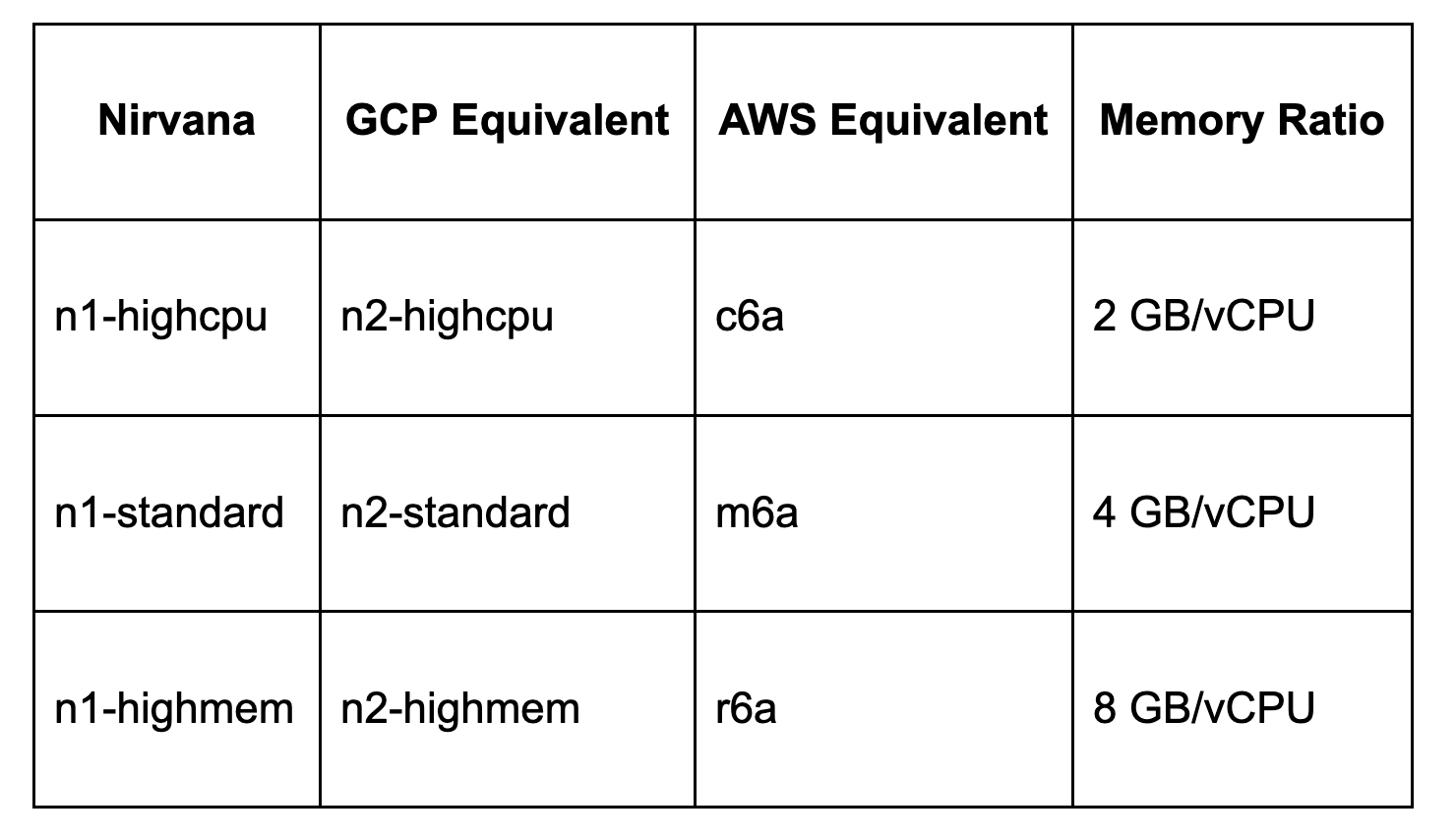
Pricing is flat: vCPU and RAM at hourly rates. Across equivalent workloads, savings range from ~26% (n1-standard vs. m6a) to ~37% (n1-highcpu and n1-highmem vs. c6a/r6a).
Full pricing breakdowns are in our FAQ and pricing page.
Available Now on VMs and Kubernetes
Instance types are rolling out this week across Nirvana VMs and Nirvana Kubernetes Service (NKS). The same family names, memory ratios, and pricing apply whether you're provisioning individual machines or scaling node pools in Kubernetes.
Log in to your Nirvana dashboard, head to Compute, then VMs and click create. You'll see n1-highcpu, n1-standard, and n1-highmem, listed with their size options. Pick an instance type. Deploy.
If you're running blockchain RPC, indexers, databases, data pipelines, or any latency-sensitive infrastructure - there's a Nirvana instance family built for it.
About Nirvana Labs
Nirvana Labs is a high-performance storage cloud purpose built for blockchain, AI and databases i.e. the most demanding, real-time, stateful workloads. Accelerated Block Storage (ABS) offers 20K baseline IOPS included, no over provisioning. Nirvana Kubernetes Service (NKS) with Karpenter auto-scaling, high clock-speed compute and private networking. Backed by Jump Trading, Crucible, etc with 50+ customers live in production today.
Learn more at Nirvana Labs
Nirvana Cloud | Pricing | Blog | Docs | Changelog | LinkedIn |Twitter | Telegram| YouTube
Related Posts
The expensive way to buy IOPS
If your storage bill is mostly meter, you paid the expensive way. Clouds price capacity cheap and meter IOPS on top: 60% of the bill at 20K IOPS, 84% at 80K, 91% on io2. Which workloads hit the meter, what it costs them, and whether yours should move.
Agent economics: the sandbox chapter
Storage-backed sandboxes save you twice: on idle, and on work you never redo. Fast disks. Persistent workspaces. Isolated sandboxes. And you pay for the work once. Run your agents on Nirvana.
Why Nirvana is the best place to run your AI agents
Nirvana is the best place to run your AI agents. Faster storage, a smaller bill, and more billable work out of the same agents.
Powering AI, blockchain, and
databases
